
NEWS
Outgoing Head of Civil Service, Mrs Didi Esther Walson-Jack, Commissions 100 Renewed Hope Electric Buses as Parting Gift to Federal Workers


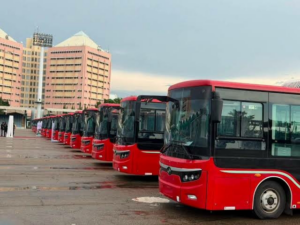
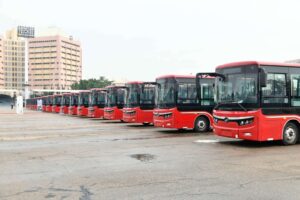
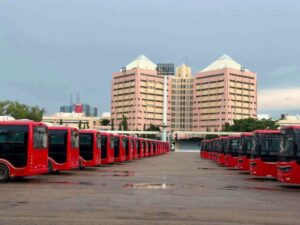
The Federal Government has commissioned 100 Renewed Hope Mass Transit Electric Buses acquired for federal civil servants, in a major intervention aimed at easing the burden of transportation, improving workers’ welfare and boosting productivity across the Federal Civil Service.
The initiative was formally unveiled at Eagle Square in Abuja by the outgoing Head of the Civil Service of the Federation, Mrs Didi Esther Walson-Jack, who described the project as a practical demonstration of the Federal Government’s commitment to improving the daily lives and working conditions of civil servants. At the commissioning ceremony, 37 of the 100 electric buses were presented as the first batch of the vehicles procured under the Renewed Hope Infrastructure Development Fund.
For Walson-Jack, however, the occasion carried even deeper personal significance. With her tenure as Head of the Civil Service of the Federation due to end within 24 hours, she described the electric bus initiative as her final and enduring contribution to the welfare of federal workers.
“It is with so much joy in my heart that I welcome you to this epoch-making commissioning of 100 Renewed Hope Mass Transit Electric Buses for federal civil servants.
“What we have here is 37 buses, being the first instalment of the 100 Electric Buses,” Mrs Walson-Jack stated.
The outgoing Head of Service said she could not have wished for a more meaningful conclusion to her tenure than to hand over an intervention designed to continue serving civil servants long after she leaves office.
“I could not have asked for a more fitting note on which to close this chapter of service than receiving and handing over the keys to something that will keep moving, keep working, long after I have gone home,” she said.
Walson-Jack stressed that transportation was far more than simply moving workers from one point to another, noting that the daily struggle of commuting directly affects the finances, safety, punctuality, physical wellbeing and overall productivity of civil servants.
According to her, an efficient and affordable transportation system could significantly reduce the pressure workers face before arriving at their duty posts, while also helping them get to work in a better physical and emotional state.
“An intervention that makes transportation safer, more reliable, and more affordable is, therefore, not a peripheral welfare gesture; it is an investment in a more productive Civil Service,” she said.
She explained that the deployment of the buses was a clear signal that the Federal Government understood the everyday realities confronting its workforce and was taking practical steps to address them.
The initiative, she said, forms part of the broader welfare and reform efforts of President Bola Ahmed Tinubu’s administration, which include the upward review of the national minimum wage, the wage award introduced following the removal of fuel subsidy, digitalisation and ease-of-service reforms, as well as renewed attention to pensions, promotions, employee compensation and health insurance.
Walson-Jack maintained that government reforms should not exist only on paper or in policy announcements but must translate into tangible benefits that workers can experience in their everyday lives.
“The Renewed Hope Agenda lives not only in policy documents, but in interventions that Civil Servants can see, board, and feel the benefit of every day,” she said.
She expressed gratitude to President Tinubu for his continued support for civil servants and his administration’s efforts towards transforming the Federal Civil Service.
According to her, no Civil Service can function effectively without workers who are adequately supported, motivated and equipped to deliver quality services to the Nigerian people.
The outgoing Head of Service also commended the Minister of State for Industry, Trade and Investment, Senator John Owan Enoh, for supporting the project and personally undertaking the symbolic handover of the buses.
She equally acknowledged the contributions of the Permanent Secretary, Ministry of Petroleum Resources, Mrs Patience Oyekunle; the Permanent Secretary, Service Welfare Office, Dr Garba Abdul Sule; the Permanent Secretary, Federal Ministry of Industry, Trade and Investment, Dr Chris Isokpunwu; and their respective teams.
Walson-Jack further recognised the support of the Chairman of the Nigeria Revenue Service, Dr Zacch Adedeji, towards the realisation of the project, as well as the Director-General of the National Automotive Design and Development Council, Otunba Oluwemimo Joseph Osanipin, and his team.
While celebrating the arrival of the buses, she emphasised that their long-term success would depend on the establishment of a strong and sustainable operational framework.
She said routes and schedules must be transparent, equitable and responsive to areas where civil servants have the greatest transportation needs.
The management of the buses, she added, must also prioritise proper maintenance, the engagement of qualified drivers, passenger safety, cleanliness and effective monitoring.
According to Walson-Jack, operations will begin with a pilot phase on selected routes, after which full deployment will commence once all necessary logistics have been concluded.
She disclosed that the buses would also be deployed to Federal Secretariats across the states where necessary, ensuring that the intervention reaches civil servants beyond Abuja.
“A Special Purpose Vehicle has been established to ensure their proper management, maintenance and long-term sustainability,” she said.
The outgoing Head of Service urged federal workers to see the electric buses as valuable public assets that must be protected and used responsibly.
“They are yours to use, but also yours to protect,” she said.
She also called on beneficiaries to reciprocate the government’s investment by demonstrating greater punctuality, productivity and dedication to their duties.
Walson-Jack said the ultimate objective of reducing the financial, physical and emotional stress associated with daily commuting was to enable civil servants to arrive at work better prepared to discharge their responsibilities.
“That is the entire logic of what we launch today: productivity, dignity and safety, delivered on four wheels,” she said.
As she prepares to leave office on Thursday, Walson-Jack charged those who would oversee the operation and management of the buses to ensure that the intervention remains functional and beneficial to civil servants for many years to come.
“I may leave office tomorrow, but these buses and the reform journey of the Federal Civil Service must keep moving. There should be no breakdown on either route!” she said.
Walson-Jack thereafter formally commissioned the 100 Renewed Hope Mass Transit Electric Buses for the Federal Civil Service, dedicating the initiative to the welfare of federal workers and the broader goal of improving service delivery to Nigerians.
The commissioning marks another major welfare intervention for federal civil servants, with the government seeking to turn its commitment to workers’ wellbeing into practical support that can be felt daily on the road to work and ulti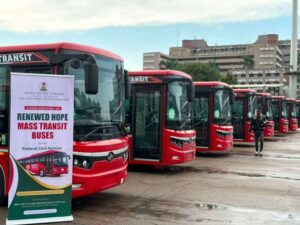
 mately in the quality of services delivered to the nation.