
NEWS
President Trump Moves to Expel South Africa and Rwanda From US AGOA Trade Programme, Threatens Billions in Duty-Free Exports From January 2027

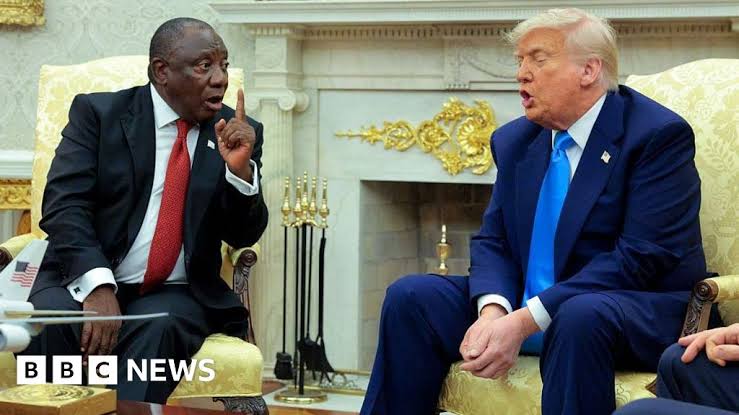
The administration of United States President Donald Trump has announced plans to suspend South Africa and Rwanda from its flagship African trade preference programme, the African Growth and Opportunity Act (AGOA), in a major trade policy decision that could disrupt billions of dollars in exports from the two African countries to the American market.
The decision, which is scheduled to take effect on January 1, 2027, represents another significant escalation in Washington’s trade and diplomatic tensions with Pretoria and comes amid growing disagreements between the Trump administration and African governments over foreign policy, human rights, national security and regional security concerns.
US Trade Representative Jamieson Greer disclosed on Monday that the United States had notified Congress of its intention to suspend both countries from AGOA, citing alleged violations of the programme’s eligibility requirements, including concerns about human rights, corruption, trade barriers and activities considered detrimental to American interests.
The African Growth and Opportunity Act, established in 2000, has remained one of Washington’s most important economic engagement instruments with sub-Saharan Africa, granting eligible African countries preferential, duty-free access to the enormous United States consumer market for thousands of products.
Announcing the decision, Greer said: “President Trump found that the governments of Rwanda and South Africa are engaging in practices that are inconsistent with AGOA’s eligibility criteria,” Greer said in a statement.
The proposed suspension could have considerable economic consequences, particularly for South Africa, which has historically been the largest beneficiary of the programme, with exports to the United States spanning automobile components, citrus products, wine and other manufactured and agricultural goods.
SOUTH AFRICA BEARS THE BIGGEST ECONOMIC RISK:
South Africa is expected to face the most significant immediate economic consequences of the decision, having exported approximately $1.7 billion worth of goods to the United States under AGOA in 2025. Its automotive industry, agricultural producers and wine exporters are among the sectors that could be affected when the preferential trade arrangements are withdrawn. The latest decision also comes against the background of deteriorating relations between Washington and Pretoria since Trump returned to the White House.
The Trump administration has repeatedly accused the South African government of persecuting white South Africans, allegations that Pretoria has strongly rejected. The two countries have also been increasingly divided over South Africa’s foreign policy positions, particularly its legal action against Israel at the International Court of Justice over allegations of genocide in Gaza, which Israel denies. Despite the impending suspension, South Africa’s trade ministry has indicated that the country will not abandon its economic relationship with the United States.
In a statement issued late Monday, the ministry said it would support industries affected by the decision while continuing to pursue trade, investment and mutually beneficial economic opportunities with Washington.
“AGOA remains important to South Africa, but it does not constitute the totality of the economic relationship between South Africa and the United States,” it said in a statement. The statement suggests that Pretoria is preparing to manage the potential disruption while exploring alternative arrangements to protect its exporters and maintain access to international markets.
RWANDA ALSO FACES WASHINGTON’S TRADE SANCTIONS:
Rwanda’s inclusion in the suspension announcement has introduced another dimension to the growing diplomatic and economic confrontation between the United States and African governments. Washington accused both countries of maintaining practices that undermine American commercial interests and create concerns relating to national security and foreign policy in the region.
Regarding Rwanda, the United States specifically highlighted concerns about human rights and the rule of law.
International observers believe Kigali’s suspension could be connected to the continuing conflict in eastern Democratic Republic of Congo, where Washington has accused Rwanda of supporting armed rebel groups operating in the region.
Rwanda has faced international pressure over the conflict, with the United States already imposing sanctions on several Rwandan individuals and institutions, including elements of its military and a gold refinery. The country has also experienced restrictions under AGOA since 2018, when Washington partially suspended its eligibility following a disagreement over import tariffs affecting second-hand clothing. That earlier restriction prevented Rwanda from exporting apparel products to the United States under the preferential trade arrangement. There was no immediate reaction from the Rwandan government following the latest announcement.
US DEMOCRATS QUESTION TRUMP’S DECISION:
The decision to remove South Africa from AGOA has also attracted criticism from opposition lawmakers in the United States, with senior Democratic figures questioning the justification and broader implications of the move.
Representative Richard Neal, the top Democratic lawmaker on the House Ways and Means Committee, criticised Trump’s decision, describing it as another example of trade policy being influenced by political grievances rather than a carefully considered economic strategy.
“It’s yet another trade decision grounded in grievance that flies in the face of what responsible policy should be,“ Neal said.
He called on the administration to provide a more comprehensive explanation of its decision and clarify what South Africa would need to do to regain eligibility for the programme. The criticism highlights the growing political disagreement within Washington over how the United States should manage its economic relationships with African countries and whether trade preferences should be used as instruments of diplomatic pressure.
EXPERTS WARN OF AFRICA’S SHIFT TOWARDS NEW TRADE PARTNERS:
Analysts believe the Trump administration’s decision could have consequences extending beyond the immediate economic losses facing South Africa and Rwanda.
Ebenezer Obadare, an expert with the Council on Foreign Relations, noted that South Africa would still be able to export goods to the United States, although its products would face less favourable trading conditions without AGOA’s preferential treatment. He also suggested that the decision could encourage African countries to accelerate efforts to diversify their international trade relationships rather than remain heavily dependent on preferential access to the American market.
According to him, even if a future American administration reverses Trump’s approach, Washington could discover that South Africa and other affected African countries have already established stronger economic relationships elsewhere.
He warned that such countries could find “new opportunities and new friends.
“I won’t be surprised if they don’t already have some alternatives lined up,” he said. “Ten percent is not a trivial number, but it’s not 90%, it’s not 60%,“ including China.
The comments reflect a broader concern that America’s use of trade restrictions as a foreign policy instrument could create opportunities for other global economic powers, particularly China, to deepen their commercial influence across Africa.
SOUTH AFRICA’S FOREIGN POLICY AT THE CENTRE OF THE DISAGREEMENT:
Beyond trade and economic considerations, South Africa’s independent foreign policy positions have emerged as a major source of friction with the Trump administration.
Washington has particularly criticised Pretoria’s decision to institute proceedings against Israel at the International Court of Justice, accusing Israel of genocide in Gaza.
The United States has opposed South Africa’s position, while Israel has consistently denied the allegations. Reacting to the AGOA decision, the US ambassador to South Africa said the outcome was regrettable but predictable.
“It is regrettable that South African policies led to the termination of AGOA for South Africa,“ said the US ambassador to South Africa in a post on X.
“This was a predictable and preventable outcome resulting from the rejection by South Africa’s government of real concerns raised by the US Government.“
The diplomatic disagreement underscores how trade relations between the two countries have become increasingly intertwined with political and geopolitical differences.
RAMAPHOSA GOVERNMENT TURNS ATTENTION TO NEW MARKETS:
Despite the potential disruption, South Africa believes the suspension, although significant, will not cripple its overall export economy Its trade ministry disclosed that exports under AGOA account for approximately 10 per cent of South Africa’s total exports to the United States and just one per cent of its total global exports.
The figures suggest that while certain industries could experience substantial pressure, the country retains considerable opportunities to redirect exports towards other international markets.
President Cyril Ramaphosa had also indicated in recent weeks that his government was preparing for the possibility of losing access to AGOA. His administration has consequently been exploring alternative export destinations, strengthening existing commercial relationships and pursuing new trade arrangements with international partners, including China. The latest development is therefore likely to intensify South Africa’s efforts to diversify its export markets and reduce its exposure to changes in American trade policy.
For the African continent, however, the planned suspension of South Africa and Rwanda raises wider questions about the future of US-Africa economic cooperation, the vulnerability of African exporters to geopolitical disagreements and the growing competition among global powers for influence in African markets.
With the January 1, 2027 deadline approaching, the coming months could prove decisive in determining whether diplomatic engagement will produce a reversal or whether the two countries will have to adjust to a new trading environment without the benefits of one of America’s longest-running preferential trade programmes for Africa.