
NEWS
Supreme Court Strengthens Civil Liberties, Rules Proxy Arrests Illegal, Protects Nigerians from Detention for Others’ Alleged Crimes

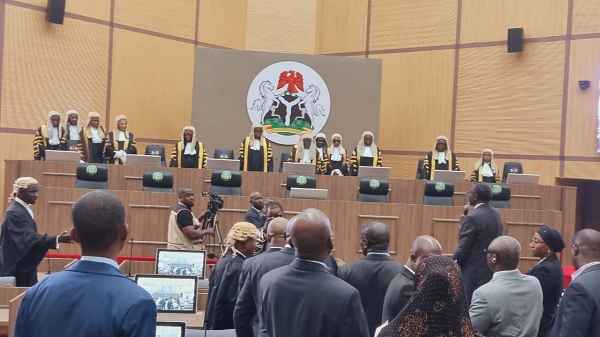
In a landmark judgment that reinforces fundamental civil liberties, the Supreme Court of Nigeria has decisively ruled that no person can be arrested for an offence allegedly committed by another individual, cementing protections under the nation’s criminal justice framework.
The judgment, delivered on January 30, 2026, in the case SC/CV/747/2024 between Mr. Smart Onomiruren and Pastor Samuel Idiokita, reaffirmed Section 7 of the Administration of Criminal Justice Act (ACJA) 2015, which expressly prohibits proxy arrests. The apex court emphasized that arrests must be grounded solely in personal liability and that law enforcement agencies cannot detain relatives, associates, or third parties to compel compliance from suspects.
The case arose from a failed business transaction involving Mr. Onomiruren and the son of Pastor Idiokita.
Pastor Samuel maintained he had no involvement in the transaction but alleged that he was unlawfully arrested, detained, and pressured to produce his son. He subsequently filed a fundamental rights enforcement suit at the Federal High Court, Warri, citing unlawful detention, harassment, threats, and violations of his constitutional rights.
The suit named several respondents, including the Inspector General of Police, the Nigeria Police Force, the Delta State Commissioner of Police, and other senior officers within Zone 5, Benin City. Pastor Samuel sought declarations that his detention and threats were unconstitutional, requested restraining orders to prevent further harassment, and sought damages for the violations suffered.
Initially, the Federal High Court dismissed the suit for lacking merit. However, the Court of Appeal overturned that decision, granting most of the reliefs sought, before the matter escalated to the Supreme Court. The apex court decisively upheld the prohibition of proxy arrests, sending a strong message to law enforcement agencies that constitutional rights cannot be subordinated to investigative convenience.
The Supreme Court also highlighted that constitutional protections remain enforceable at every stage of investigation. The judgment makes it unequivocally clear that families and associates of suspects cannot be detained to exert pressure, and victims of such practices have enforceable remedies under Nigerian law.
The case, which commenced in September 2021, reached a final resolution in under five years, a timeline described by observers as a positive precedent for the timely adjudication of fundamental rights cases. The decision is expected to boost public confidence in judicial processes and accountability in policing.
The ruling carries significant implications for citizens, law enforcement agencies, and legal practitioners alike. It firmly establishes that constitutional rights are personal, enforceable, and protected at the highest judicial level.
Legal representatives involved in the proceedings included Eric K. Omare, Esq., Zeph Omvuzulike, Esq., and M.I. Okoye, Esq. representing Pastor Samuel Idiokita, and John Okoriko, Esq., and G.A. Okoreke, Esq. representing the appellant. Onoriode William Ewonode, Esq. appeared for the Inspector General of Police and the Delta State Commissioner of Police.
The Supreme Court’s decision is being hailed as a milestone in the protection of civil liberties in Nigeria, reinforcing the principle that no individual can be made a proxy for another’s alleged criminal conduct.