
NEWS
U.S Church Pastors, Prophet Israel Ford and Pastor Lydia Ford Spark Controversy as They Introduce Second Wife, Citing God’s Will

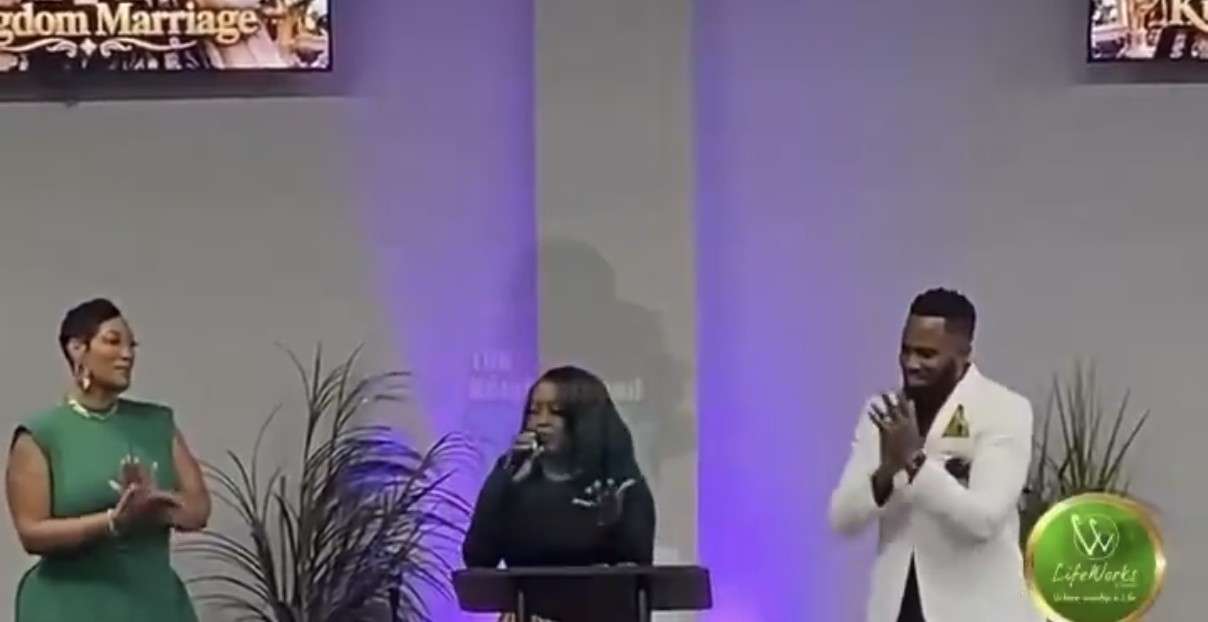
A Christian pastor in the United States has sparked widespread debate after introducing a second wife into his marriage, with the unusual arrangement reportedly presented to the congregation as God’s will and supported with a biblical reference.
Prophet Israel T. Ford and Pastor Lydia Ford, leaders of LifeWorks Church near Cleveland, Ohio, have drawn public attention following the announcement that Shakayla Ford has become Israel’s second wife.
The development has triggered mixed reactions among Christians and social media users, with some questioning the biblical justification for the arrangement while others have defended it by pointing to examples of polygamy recorded in the Old Testament.
In a particularly striking moment, Lydia reportedly introduced Shakayla to the congregation in a positive manner, an approach that has further fuelled discussions about the couple’s decision. Photographs circulating online also show Israel, Lydia and Shakayla posing together, appearing happy in one another’s company.
The situation has attracted attention because of the longstanding Christian emphasis on monogamy and the expectations surrounding marriage among church leaders.
Israel has also taken to Facebook to challenge the widely held Christian position that a man should have only one wife, arguing that the teaching is not biblically sound. In defending the arrangement, he reportedly referenced Exodus 21:10, a passage that addresses the obligations owed to a wife when a man takes another wife.
However, the development has encountered opposition from Christians who point to 1 Timothy 3:2, which states that an overseer should be the husband of one wife. The passage is frequently cited in discussions about marital expectations and the qualifications required of church leaders.
Critics argue that the New Testament teaching provides a basis for expecting pastors and other church leaders to maintain monogamous marriages. They also point to the traditional position of several major Christian denominations, which uphold marriage between one man and one woman.
On the other hand, supporters of Israel’s position have drawn attention to biblical figures who had multiple wives, arguing that polygyny appears in several accounts in the Old Testament. They contend that these examples should be considered when examining arguments about whether the practice is entirely forbidden by Scripture.
The contrasting interpretations have reignited a broader debate about biblical teachings on marriage, the distinction between Old and New Testament practices, and whether religious leaders should be held to particular marital standards.
While some observers have expressed shock at the arrangement, others have defended the couple’s decision, insisting that the issue should be examined through the lens of biblical interpretation rather than public opinion.
The controversy has continued to generate online discussions, highlighting the deep divisions among Christians over polygamy, pastoral leadership and the interpretation of Scripture in c
 ontemporary society.