
NEWS
Rev. Jesse Jackson, Towering Civil Rights Icon, Baptist Minister and Two-Time Presidential Candidate, Dies at 84 After a Lifetime of Defining the Struggle for Justice

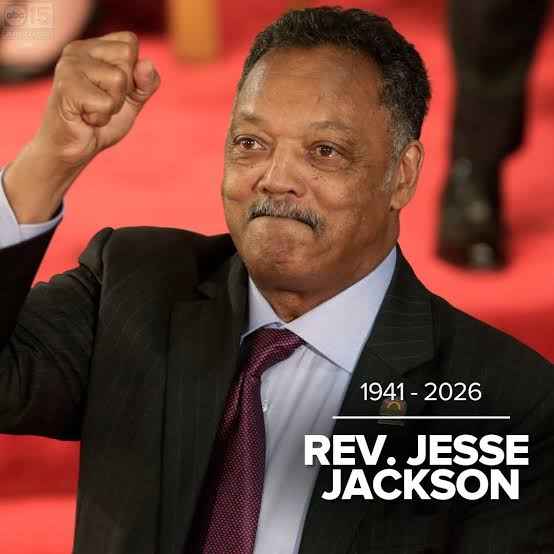
The United States and the global community are mourning the passing of the Rev. Jesse Jackson, the longtime civil rights activist, Baptist minister and two-time presidential candidate, who died Tuesday at the age of 84.
His family confirmed his passing in a heartfelt statement, announcing that he died peacefully surrounded by his loved ones. No immediate cause of death was given.
“Our father was a servant leader, not only to our family, but to the oppressed, the voiceless, and the overlooked around the world.
“We shared him with the world, and in return, the world became part of our extended family. His unwavering belief in justice, equality, and love uplifted millions, and we ask you to honor his memory by continuing the fight for the values he lived by,” the Jackson family said in a statement.
Civil rights leader Rev. Al Sharpton described Jackson’s death as a monumental loss to the nation’s moral conscience.
“our nation lost one of its greatest moral voices,” Sharpton said, paying tribute to a man who “carried history in his footsteps and hope in his voice.”
“Reverend Jackson stood wherever dignity was under attack, from apartheid abroad to injustice at home. His voice echoed in boardrooms and in jail cells. His presence shifted rooms. His faith never wavered,” Sharpton said.
A Life Shaped by Struggle and Faith
Born in Greenville, South Carolina, Jackson rose to national prominence during the civil rights era, standing shoulder to shoulder with the Rev. Martin Luther King Jr. in some of the most defining moments of America’s fight for racial justice. He participated in historic demonstrations, including the 1965 Selma-to-Montgomery march in Alabama, and became one of the most visible young lieutenants in the movement.
He began organizing with the Congress of Racial Equality, engaging in marches and sit-ins aimed at dismantling segregation. A graduate of North Carolina A&T State University with a degree in sociology, Jackson later pursued divinity studies at Chicago Theological Seminary, where he mobilized student support for King’s campaigns.
He eventually joined the Southern Christian Leadership Conference (SCLC), working alongside King full time. As head of Operation Breadbasket, the SCLC’s economic development and empowerment program, Jackson earned high praise from King himself for his effectiveness and leadership.
Jackson was in Memphis, Tennessee, with King when he was assassinated in 1968, a tragic turning point that propelled him into an even broader leadership role within the movement.
Building Institutions for Black Empowerment
In 1971, after parting ways with the SCLC, Jackson founded People United to Save Humanity (PUSH), an organization aimed at improving economic conditions in Black communities. PUSH later expanded its mission to include political engagement, direct action campaigns and social initiatives through radio programming and recognition of Black excellence.
His political activism intensified in 1984 when he launched his first campaign for the Democratic presidential nomination, forming the National Rainbow Coalition to oppose the policies of President Ronald Reagan and advocate for social programs, voting rights and affirmative action. PUSH and the National Rainbow Coalition merged in 1996 to become the Rainbow/PUSH Coalition.
In 1984, Jackson won more than 18% of the primary vote and secured victories in several primaries and caucuses. A 1984 New York Times profile noted his political influence, stating: “Merely by being black and forcing other candidates to consider his very real potential to garner black votes, which they need, Jackson has had an impact.”
Four years later, he expanded his political base, winning 11 primaries and caucuses in his 1988 presidential run, solidifying his place as a formidable force within the Democratic Party.
Reflecting on that historic campaign years later, Jackson said: “The great responsibility that we have today is to put the poor and the near-poor back on front of the American agenda. This is a dangerous mission, and yet it’s a necessary mission!”
Though his 1984 campaign faced controversy over remarks he made about Jewish people, comments for which he later offered an impassioned apology, Jackson remained a persistent voice in American political life.
Diplomatic Missions and National Recognition
Beyond electoral politics, Jackson became known for high-profile diplomatic interventions. He negotiated the release of detained Americans around the world, including three U.S. soldiers held in Yugoslavia in 1999. In recognition of his humanitarian efforts, President Bill Clinton awarded him the Presidential Medal of Freedom in 2000.
Over the decades, he also helped secure the release of a U.S. Navy pilot from Syria in 1984, Americans held in Cuba, hundreds of women and children from Iraq in 1990, and two Gambian Americans in 2012 demonstrating his unique ability to operate as a moral envoy across political boundaries.
In 1991, Jackson was elected as one of Washington, D.C.’s “shadow senators,” lobbying for D.C. statehood and serving one term.
Health Battles and Final Days
In recent years, Jackson faced significant health challenges. He revealed in 2017 that he had been diagnosed with Parkinson’s disease and had been receiving outpatient treatment at Northwestern Medicine in Chicago. For more than a decade, he also lived with progressive supranuclear palsy (PSP), a condition that affects movement, balance and swallowing and can lead to serious complications.
Despite these struggles, Jackson remained active in public discourse, speaking out on national politics. He was critical of former President Donald Trump, warning that “Fifty years of civil rights have been threatened.” He also endorsed Sen. Bernie Sanders during the 2020 presidential election, drawing praise from Sanders on the campaign trail.
“It is one of the honors of my life to be supported by a man who has put his life on the line for the last 50 years fighting for justice,” Sanders said at the time.
Family and Legacy
Jackson married Jacqueline Brown in 1962, and she survives him. They have five children, including former Rep. Jesse Jackson Jr.
Public observances will be held in Chicago, with additional celebration of life events to be announced by the Rainbow/PUSH Coalition and the Jackson family.
From jail cells to presidential debate stages, from grassroots marches to international diplomacy, the Rev. Jesse Jackson’s life embodied the relentless pursuit of justice. His voice, once a thunderous rallying cry in the streets and halls of power, leaves behind an enduring echo, one that continues to challenge nations a
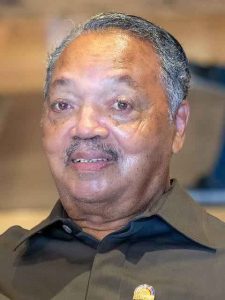 nd generations to stand for dignity, equality and hope.