
NEWS
VIDEO: Young APC Supporters Express Frustration After Receiving ₦1,500 for Full Day of Campaign Activities

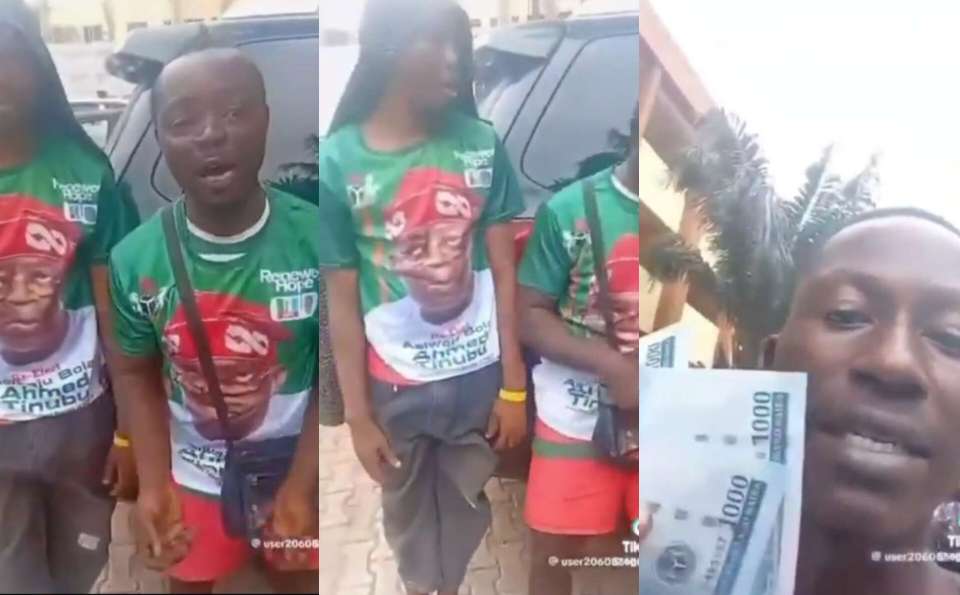
A video circulating widely on social media has sparked reactions after a group of young men reportedly expressed disappointment over the amount they received after spending an entire day participating in a political campaign.
The men, dressed in green All Progressives Congress (APC) campaign shirts bearing the image of President Bola Ahmed Tinubu, were seen displaying the money they allegedly received for their participation.
According to the footage, each of the young men was paid just ₦1,500 after spending hours dancing, chanting and campaigning under the hot sun.
One of the participants was seen holding up the cash towards the camera, while others stood around him in their campaign-branded shirts, appearing frustrated and visibly exhausted.
The scene has renewed conversations about the growing practice of paid political mobilisation in Nigeria, particularly during election periods.
Often described as a rent-a-crowd arrangement, the practice involves political parties, candidates or campaign organisers mobilising groups of people to attend rallies and public events in large numbers. Participants may receive branded clothing, transportation, food and stipends in exchange for their presence and participation.
While such arrangements have existed for years, the widespread use of smartphones and social media has dramatically changed how they are exposed to the public.
In the past, participants might have collected their payments and quietly returned home. Today, however, individuals can immediately record videos, document their experiences and publish their grievances online, potentially reaching thousands or even millions of people.
The reported ₦1,500 payment has therefore become the focus of attention, with many questioning whether the amount adequately reflects a full day’s participation in a political campaign.
For young Nigerians already struggling with rising transportation, food and living costs, the sum could represent little more than a fraction of their daily expenses. The situation also highlights the difficult economic circumstances that can make even small payments attractive to people searching for temporary sources of income.
Beyond the immediate controversy, the incident has revived broader concerns about the nature of political mobilisation in Nigeria.
Critics have long argued that large crowds at political rallies do not necessarily translate into genuine or sustained grassroots support. A crowd may create an impressive visual display for television cameras and social media, while many of those present may simply be responding to the opportunity to earn some money.
For the participants, the arrangement can also be purely transactional. Once the rally ends and the payment is collected, they return to their everyday lives and the economic challenges that existed before the campaign event.
The viral footage consequently presents a striking picture of the intersection between politics, unemployment and economic hardship.
There is an element of irony in seeing campaigners who were brought together to project enthusiasm publicly reveal their dissatisfaction over what they received. At the same time, the episode points to a more serious reality about the value placed on the time, labour and energy of economically vulnerable Nigerians.
As political activities intensify ahead of future elections, similar scenes could continue to emerge, particularly as social media gives participants the ability to document what happens behind the scenes.
The colours of the campaign shirts may change, the politicians may change and the slogans may change, but the underlying transaction remains familiar: people provide their presence and energy, while politicians gain the appearance of a large and enthusiastic crowd.
For many of those involved, however, the decision to return may have less to do with political conviction 
 than with economic necessity.