
NEWS
Capacity Building for Climate-Resilient Agriculture: JR Biotek Foundation, Mastercard Foundation, University of Cambridge Partner MOUAU to Train Nigerian Scientists in Advanced Molecular Biotechnology

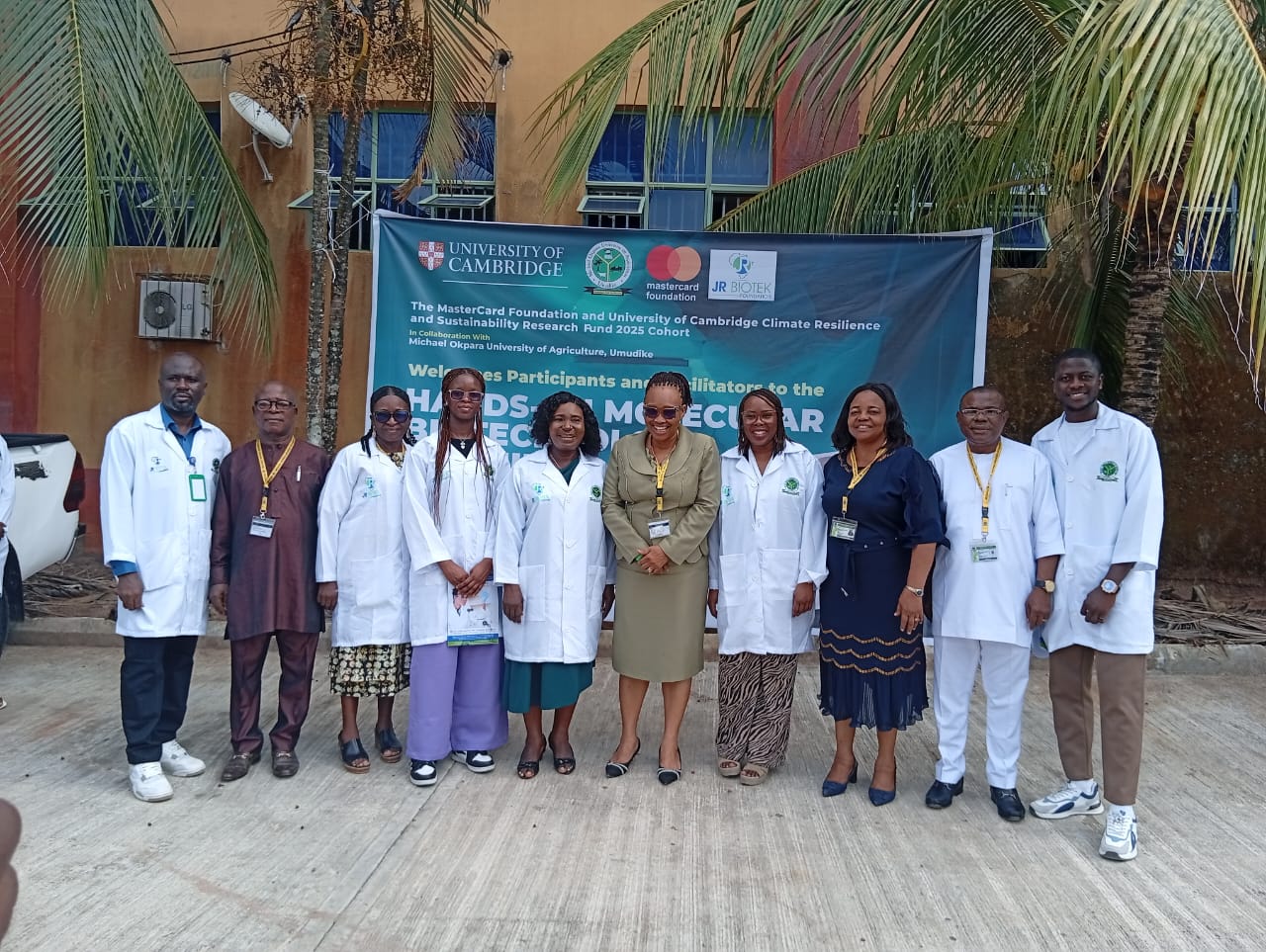
In a significant step toward strengthening Nigeria’s agricultural resilience and scientific capacity, the JR Biotek Foundation, the Mastercard Foundation, and the University of Cambridge, United Kingdom (UK), in collaboration with Michael Okpara University of Agriculture, Umudike (MOUAU), has trained Nigerian scientists in molecular biotechnology to enhance the country’s preparedness for climate-resilient agriculture.
The training, held recently at MOUAU in Abia State, was organised as a hands-on workshop titled; “Building Nigeria’s Capacity for Climate-Resilient Agriculture Through Molecular Biotechnology.” The programme brought together selected scientists from across Nigeria for intensive practical exposure to cutting-edge biotechnology tools and techniques.
In her remarks, JR Biotek Foundation’s Founder and Principal Investigator, Dr. Carol Ibe, explained that the initiative was specifically designed to equip Nigerian scientists with modern biotechnology skills needed to tackle the pressing challenges of climate change and food security.
The Cambridge researcher, who leads the project as the United Kingdom lead with grant funding from the Mastercard Foundation and University of Cambridge, further noted that the programme focuses on advanced molecular biology techniques and their applications in crop science and agricultural innovation.
According to her, these tools are critical in developing climate-resilient agricultural systems as the effects of climate change continue to intensify.
Reflecting on her motivation, Dr. Ibe revealed that her passion for the initiative stems from her academic journey and a deep commitment to giving back to the system that shaped her career.
“I have always had it in mind to give back to the system that shaped my career. The resilience I received from MOUAU informed my decision to contribute to society through initiatives like this,” she said.
Dr. Ibe observed that although Nigerian scientists possess strong intellectual capacity, limited access to modern laboratory infrastructure continues to hinder their ability to compete globally.
“These challenges are systemic and require deliberate attention from government and stakeholders. When universities lack standard laboratories and infrastructure, it directly affects students and researchers,” she said.
She warned that climate change is already altering rainfall patterns and threatening biodiversity in Nigeria, including several indigenous crops that possess valuable genetic traits for improving global food security.
“We are losing many of our indigenous crops that contain genetic resilience needed for sustainable food systems. Unfortunately, we are not doing enough research on them,” she said.
Highlighting the impact of the programme, Dr. Ibe disclosed that JR Biotek Foundation initiatives have already trained over 300 scientists from more than 20 African countries, with Nigeria accounting for the highest number of beneficiaries.
She further revealed that the current training at MOUAU attracted an overwhelming 1,661 applications from across Nigeria’s geopolitical zones for only 20 available slots.
“This shows the huge demand for this type of training. Unfortunately, we could only accommodate a small number due to limited resources,” she said.
Beyond physical workshops, Dr. Ibe noted that more than 20,000 scientists across Africa and parts of Southeast Asia have benefited from the foundation’s virtual training programmes.
She also disclosed that all laboratory equipment and consumables brought from the United Kingdom for the training would remain at MOUAU to support continued research and capacity building.
“All the equipment and materials we brought will remain here at the university so that students and researchers can continue building from this foundation,” she said.
Dr. Ibe stressed that sustained investment in research and development is essential to maintain the progress achieved through such collaborations.
According to her, the long-term vision of the partnership is to build a strong research ecosystem focused on African indigenous crops and climate-resilient food systems.
She added that the JR Biotek Foundation aims to support 10 million smallholder farmers across Africa, train 10,000 African scientists, catalyse 1,000 climate-smart food ventures and add value to at least 30 indigenous crops.
Declaring the workshop open, the Vice-Chancellor of MOUAU, Prof. Ursula Ngozi Akanwa, expressed delight over the collaboration, describing it as a major boost for research development and scientific advancement in the institution.
Prof. Akanwa noted that the programme was particularly gratifying because Dr. Ibe, one of the facilitators, is an alumnus of the university. She urged members of the university’s alumni community, especially those in the diaspora, to emulate Dr. Ibe by giving back to the institution that contributed to their academic and professional growth.
The Vice-Chancellor welcomed the visiting team from the University of Cambridge and expressed optimism that the collaboration would open new opportunities for research and institutional development.
She also expressed concern over the growing impact of climate change, noting that its consequences are already affecting agriculture, health and the environment. She stressed the need for collective efforts to mitigate its impact through research, innovation and strategic partnerships.
Also speaking, a Professor of Soil Science at MOUAU and Nigeria Project Lead, Prof. Olayinka Nwachukwu, stated that the collaboration between the University of Cambridge, the Mastercard Foundation, JR Biotek Foundation and MOUAU would significantly strengthen Nigeria’s capacity in biotechnology research and climate-resilient agriculture.
Prof. Nwachukwu explained that the project was co-developed with Dr. Carol Ibe, who serves as the Principal Investigator and Project Lead in the United Kingdom. She added that the workshop was designed to equip Nigerian scientists with practical biotechnology skills needed to develop innovative solutions for climate-resilient agricultural systems.
“The training focuses on biotechnology tools such as DNA extraction, DNA sequencing, genomics and bioinformatics, which are essential for building resilience in agriculture as climate change intensifies,” she said.
She further noted that although Nigerian scientists are highly competent, many institutions still face limitations due to inadequate research infrastructure.
“Nigerian scientists are top-notch despite the challenges we face. Most of these challenges stem from the lack of adequate equipment rather than the quality of education we have received,” she said.
According to her, the visiting team from the United Kingdom brought several research tools and laboratory equipment that will be donated to MOUAU after the training.
In his remarks, the Project Co-Lead in Nigeria, Dr. George Okoro, disclosed that participants in the programme were drawn from institutions across Nigeria, including Usmanu Danfodiyo University, Sokoto, University of Maiduguri, Lake Chad Research Institute and Federal University Otuoke, among others.
He maintained that the initiative is expected to create a multiplier effect as participants will replicate the training in their respective institutions.
Dr. Okoro added that the collaboration would strengthen the ability of Nigerian scientists to conduct innovative research and compete for international research grants while contributing to sustainable food production in the face of climate change.