
NEWS
“Guns-a-Blazing”: Trump Doubles Down, Threatens Military Strikes and Aid Cut to Nigeria Over “Christian Killings,” Declares “Country of Particular Concern”

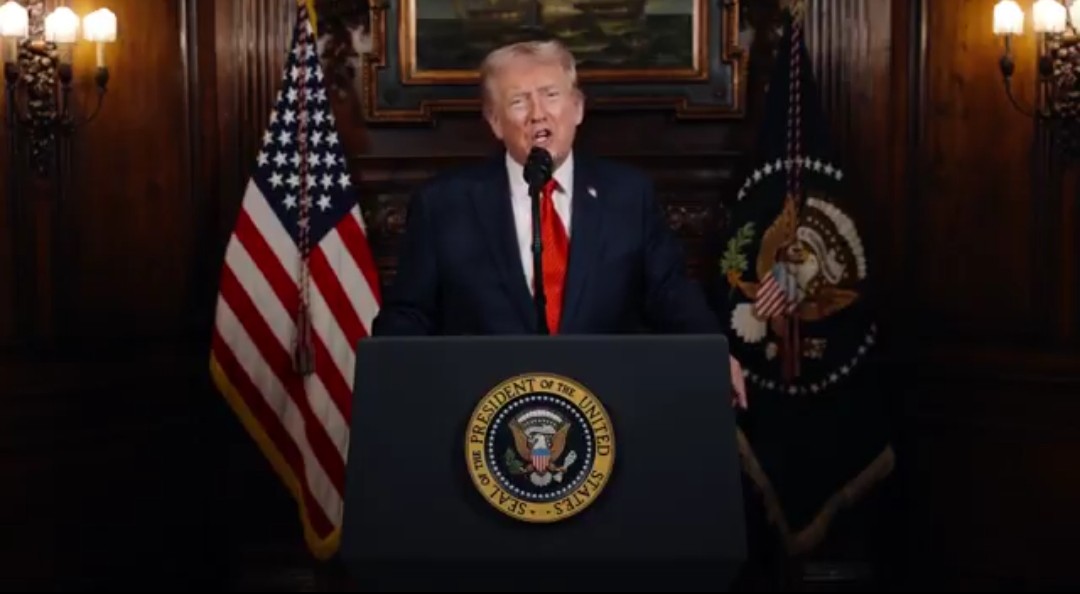
In a forceful and highly consequential escalation of U.S. rhetoric toward Nigeria, President Donald Trump has re-designated the West African nation as a “country of particular concern” and openly threatened to cut aid and even order military strikes unless the Nigerian government acts immediately to halt what he described as a campaign of killings targeting Christians.
Speaking in a video address behind a lectern bearing the seal of his office, Mr. Trump framed the situation in stark, personal terms and warned of swift U.S. action if Nigerian authorities did not move decisively to protect vulnerable communities. He said the United States would not simply resort to diplomatic pressure but had ordered preparations for possible forceful intervention.
“If the Nigerian government continues to allow the killing of Christians, the USA will immediately stop all aid assistance to Nigeria,” Trump said.
“We are going to do things to Nigerians that Nigeria is not going to be happy about and may very well go into that now disgraced country, guns-a-blazing to completely wipe out the Islamic terrorists who are committing these horrible atrocities.
“I am hereby instructing the Department of War to prepare for possible actions. If we attack, it is going to be vicious and sweet just as the terrorist thugs attack our chrished chirstians. The Nigerian government had better move fast before it is too late.
“Christianity is facing an existential threat in Nigeria. Thousands and thousands of Christians are being killed. Radical Islamists are responsible for this mass slaughter.”
Those blunt warnings follow Mr. Trump’s October 31 formal move to place Nigeria back on the U.S. watch-list for severe violations of religious freedom, a step that opens the door to a range of penalties, including suspension of certain kinds of U.S. aid. U.S. lawmakers and religious-freedom advocates who have pushed for the designation hailed the decision; Nigerian officials have pushed back, saying the country’s complex security challenges affect communities across faiths and cautioning against simplistic labels.
In his address Mr. Trump also called on members of Congress to act quickly.
“I am asking congressman Riley Moore, together with chairman Tom Cole and the house appropriations committee, to immediately look into this matter and report back to me,” he said, directing two influential House Republicans to investigate and accelerate potential U.S. responses.
Beyond the administration’s rhetoric, the threats carry real diplomatic and operational implications. Adding Nigeria to the “country of particular concern” list revives a legal pathway for sanctions and curtailment of assistance, while talk of military action and the instruction to “prepare” for it raises acute questions about how the U.S. might act in a sovereign country where it already provides security cooperation, and how Abuja and regional partners will respond.
Analysts warn that any kinetic intervention would risk wider instability and further complicate the fight against multiple armed groups across Nigeria’s north and middle belt.
The White House statement and Mr. Trump’s video have also intensified lobbying and legislative activity in Washington: some Republicans are pressing for tougher measures, including targeted sanctions on those alleged to be responsible for attacks, and for urgent congressional inquiries into the scale and causes of religiously-motivated violence. At the same time, international and Nigerian officials are urging caution, saying the situation on the ground is complicated by banditry, communal clashes and competing insurgencies that affect people of many faiths.
Trump concluded his address by reaffirming a broad ideological frame: “The United States cannot stand by while such atrocities are happening in Nigeria and numerous other countries…
“We stand ready, willing, and able to save our great Christian population around the world.”
The blunt language, mixing legal designation, cuts to aid, and the specter of force marks one of the clearest and most dramatic U.S. interventions of rhetoric (and possible policy) into Nigeria’s long-running security crisis.