
NEWS
JUST IN: PRESIDENT TINUBU’S REFORMS YIELD GLOBAL RECOGNITION, AS NIGERIA REMOVED FROM FATF GREY LIST, MARKING A MAJOR MILESTONE IN ECONOMIC RESTRUCTURING AND FINANCIAL CREDIBILITY


Nigeria has achieved another significant milestone in its ongoing reform journey under the leadership of President Bola Ahmed Tinubu, as the country has been officially removed from the Financial Action Task Force (FATF) Grey List, a global watchlist for nations under enhanced monitoring for money laundering and terrorism financing risks.
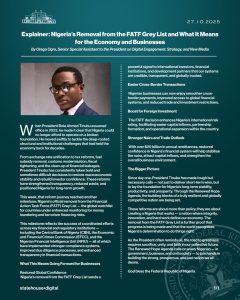
Otega Ogra, Senior Special Assistant to the President on Digital Engagement, Strategy, and New Media, explained that “When President Bola Ahmed Tinubu assumed office in 2023, he made it clear that Nigeria could no longer afford to operate on a broken foundation. He moved swiftly to tackle the deep-rooted structural and institutional challenges that had held the economy back for decades.”
According to Ogra, “From exchange rate unification to tax reforms, fuel subsidy removal, customs modernisation, fiscal tightening, and the clean-up of financial leakages, President Tinubu has consistently taken bold and sometimes difficult decisions to restore macroeconomic stability and rebuild investor confidence. These reforms have strengthened transparency, reduced waste, and positioned Nigeria for long-term growth.”
The removal from the FATF Grey List marks a validation of Nigeria’s aggressive institutional and financial reforms. Ogra emphasized that this development “reflects the success of coordinated efforts across key financial and regulatory institutions, including the Central Bank of Nigeria (CBN), the Economic and Financial Crimes Commission (EFCC), and the Nigerian Financial Intelligence Unit (NFIU).”
He added that these agencies have “implemented stronger compliance systems, improved due diligence processes, and enhanced transparency in financial transactions,” leading to restored international confidence in Nigeria’s financial credibility.
Nigeria’s removal from the FATF Grey List sends a powerful signal to international investors, financial institutions, and development partners that the nation’s financial systems are credible, transparent, and globally trusted. Businesses across Nigeria can now benefit from smoother cross-border payments, improved access to global financial systems, and reduced trade and investment restrictions.
The FATF decision enhances Nigeria’s international risk rating, making it easier for investors to channel capital into the economy, form global partnerships, and expand business operations within the country. With over $20 billion in annual remittances, renewed confidence in the nation’s financial systems will help stabilize the naira, attract new capital inflows, and create a more favorable environment for trade and industry.
Since assuming office, President Tinubu has taken tough but essential decisions not merely for short-term relief, but to lay a firm foundation for Nigeria’s long-term stability, productivity, and prosperity. Through the Renewed Hope Agenda, his administration is rebuilding the nation’s economic and institutional frameworks to ensure Nigeria’s resilience and global competitiveness.
As Ogra stated, these reforms “are about more than policy; they are about creating a Nigeria that works, a nation where integrity, innovation, and hard work define our economy.” The removal from the FATF Grey List stands as further proof that progress is being made and that the world recognizes Nigeria’s determination to strengthen its systems, restore transparency, and rebuild trust in governance.
President Tinubu has consistently reminded Nigerians that “the road to greatness requires sacrifice, unity, and faith in our collective future.” The Renewed Hope Agenda invites every Nigerian across government, business, and civil society to join hands in building the strong, prosperous, and just nation we all desire.
God bless the Federal 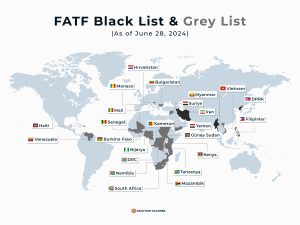

 Republic of Nigeria.