
NEWS
MediNews Spotlights a Trailblazer: Prof. Chimezie Okwuonu and the Bold New Frontier of Kidney Care in Nigeria

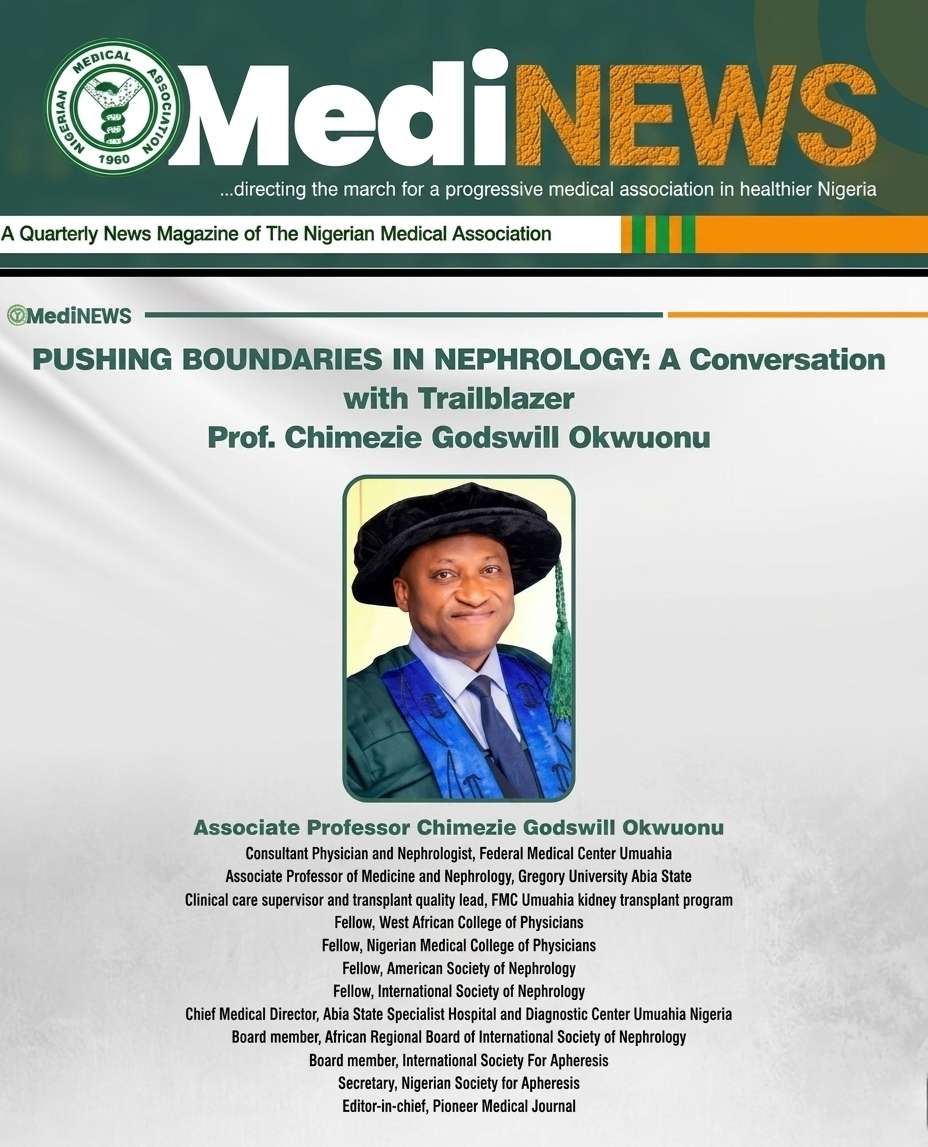
The 2026 Quarterly News Magazine of the Nigerian Medical Association, MediNews Newsletter, has cast a well-deserved spotlight on one of Nigeria’s foremost nephrologists, Prof. Chimezie Godswill Okwuonu, a man whose life’s work is redefining kidney care and giving hope to patients once condemned by renal disease.
Currently serving as the Chief Medical Director of the Abia State Specialist Hospital and Diagnostic Center, Prof. Okwuonu’s journey is one marked by resilience, innovation, and an unwavering commitment to saving lives. From his roots in Itaja Olokoro, Umuahia, to global training stints and leadership roles across prestigious medical institutions, his career reflects both depth and purpose.
Prof. Okwuonu’s decision to specialize in nephrology was deeply personal. The loss of a close friend during his university days, followed by the death of one of his earliest patients as a young doctor, became defining moments. In a striking act of compassion, he once spent his entire first salary funding a patient’s dialysis treatment miles away from the hospital. That experience ignited a lifelong mission to change the narrative of kidney disease in his community.
As a Consultant Physician and Nephrologist at the Federal Medical Center Umuahia, he played a pioneering role in establishing Southeast Nigeria’s first kidney transplant program in 2017. What began as a bold vision has now matured into a life-saving reality. Under his clinical supervision and quality leadership, the center has successfully performed thirteen kidney transplants, recording a one-year graft survival rate of 90 percent and a three-year rate of 70 percent. These outcomes, published in the West African Journal of Medicine, reinforce growing confidence in Nigeria’s ability to deliver world-class specialized care.
For Prof. Okwuonu, the achievement extends beyond clinical statistics. It represents extended life and renewed hope, with patients who once faced a prognosis of less than a year on dialysis now living for many years post-transplant and returning to normal life.
Operating in a resource-constrained environment, the transplant team adopted innovative and unconventional strategies to achieve success. From producing their own perfusion fluids to improvising procedural techniques in the absence of certain medical equipment, the team demonstrated remarkable ingenuity. Strategic collaborations with institutions such as the University of Toledo Medical Center and the University of Virginia Health System facilitated vital knowledge transfer and technical support, while partnerships supported by the International Society of Nephrology helped strengthen expertise without placing undue strain on local resources.
Beyond clinical practice, Prof. Okwuonu has made significant contributions to healthcare policy and national medical standards. His involvement in drafting revised guidelines for chronic kidney disease management, organ transplantation ethics, and dialysis operations highlights his expanding influence within Nigeria’s healthcare system. As a member of regional and international nephrology boards, he continues to advocate for systemic reforms, including expanded health insurance coverage, government support for transplant services, and the establishment of a National Kidney Institute.
He maintains that Nigeria is steadily advancing toward self-sufficiency in specialized medical care. By successfully conducting complex procedures locally, the country can reduce dependence on medical tourism while strengthening its healthcare infrastructure and retaining critical expertise.
To aspiring medical professionals, Prof. Okwuonu emphasizes resilience, purpose, and a commitment to applying global knowledge locally. Despite the demanding nature of nephrology and transplant medicine, he describes the field as deeply rewarding, particularly in the lives restored through successful treatment.
Balancing the demands of clinical leadership with personal life, he credits discipline, teamwork, and strong organizational capacity for sustaining effectiveness across his roles.
Looking ahead, his vision is to establish the kidney transplant program at FMC Umuahia as a leading center of excellence in Africa. He hopes his legacy will reflect a career dedicated to bridging the gap between advanced medical innovation and accessible healthcare for Nigerians.
As captured by MediNews, Prof. Chimezie Okwuonu stands at the forefront of a transformative era in Nigerian medicine, demonstrating that with vision, commitment, and innovation, even the most complex healthcare challenges can be overcome.