
NEWS
Obi-Kwankwaso Movement Unveils 59-Member Campaign Council Ahead of 2027 Elections

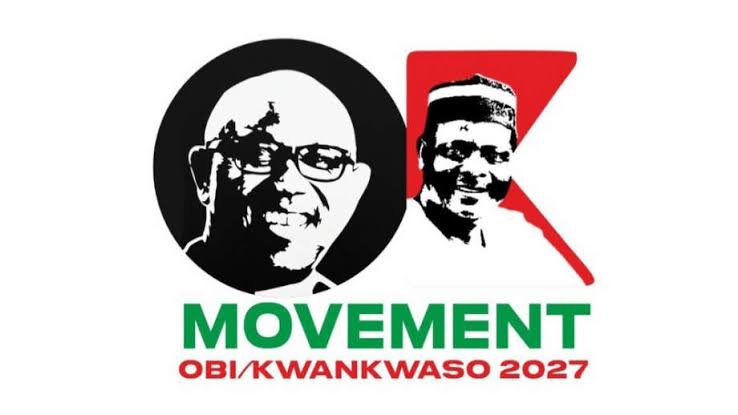
The Obi-Kwankwaso Movement, popularly known as the OK Movement, has unveiled a 59-member Presidential Campaign Council as it steps up preparations to mobilise support for the joint presidential ticket of the Nigeria Democratic Congress (NDC) candidate, Peter Obi, and his running mate, Rabiu Kwankwaso, ahead of the 2027 general elections.
The campaign council, announced on Thursday, is structured to cover Nigeria’s six geopolitical zones, the Federal Capital Territory (FCT) and all 36 states, reflecting the movement’s stated intention to establish a broad grassroots campaign network across the country.
The newly unveiled structure comprises zonal and state coordinators as well as directors responsible for key areas of the campaign, including grassroots mobilisation, women affairs, contact and engagement, special duties, procurement, information technology, legal affairs, strategy and planning, security and intelligence, and administration.
The Director-General of the movement, John Ughulu, was appointed Director-General of the Presidential Campaign Council, while the National Secretary, Saadatu Sani, was also included in the campaign leadership.
In a congratulatory message to the newly appointed members, Sani described their selection as a responsibility that goes beyond receiving political appointments, urging them to dedicate themselves to the mobilisation effort and the wider objectives of the movement.
“Your selection is not merely an appointment; it is a call to duty, sacrifice, leadership and service to Nigeria. At this critical moment in our nation’s history, the responsibility before the Presidential Campaign Council is enormous,” she said.
Sani charged the campaign council members to move beyond major urban centres and take the movement’s message directly to voters at the grassroots, including local government areas, wards and communities.
“You have been entrusted with the task of taking the vision, message and aspirations of our principals directly to the Nigerian people from the cities to the grassroots, from the states to the local governments, and from the wards to every community across the federation.
“Your appointment is an honour, but more importantly, it is a responsibility. The journey has begun. The assignment is clear. The mission is Nigeria,” Sani stated.
She further explained that the movement intended to build its campaign around what it described as a broader national objective rather than the personal ambitions of individual politicians.
“The OK Movement is not built around individuals seeking personal recognition. It is a movement driven by a larger national vision: to mobilise Nigerians around the possibility of a better, more prosperous, united and functional Nigeria,” she added.
The National Secretary also called on members of the council to approach their responsibilities with discipline, loyalty, humility and commitment, stressing the importance of coordination as the campaign structure expands across the country.
According to her, the scale of the assignment would demand sustained grassroots mobilisation, strategic planning, effective communication and cooperation among the various arms of the campaign.
“The road ahead will require hard work. It will require strategic thinking, grassroots mobilisation, effective communication and, above all, the ability to work together as one formidable political family,” she said.
Sani said the immediate responsibility before the newly inaugurated campaign structure was to ensure that the message of Obi and Kwankwaso is communicated to Nigerians across the country.
“Our responsibility is to ensure that the message of our principals reaches every Nigerian and that the voice of the people is heard across the length and breadth of our nation,” she stated.
The council has zonal leadership covering the six geopolitical zones. Suleiman Abubakar was appointed coordinator for the North-Central, Hashimu Dungurawa for the North-West, Amadu Gwambe for the North-East, Dr Adebayo Adefolaseye for the South-West, Christopher Ighodaro for the South-South, and El-Shaddai Ikeh for the South-East.
State-level coordinators were also appointed for all 36 states and the Federal Capital Territory, giving the movement a nationwide organisational framework as preparations for the 2027 elections gather momentum.
Several other officials were assigned specialised responsibilities within the campaign council. Rev. Mike Agbon was appointed Director of Inter-Ethnic Group in Northern Nigeria, while Sabo Gashua was named Director of Grassroots Mobilisation.
Glory Adayi will oversee Women Affairs, Kabir Yahaya will serve as Director of Contact and Engagement, and Abdumumini Tijjani was appointed Director of Mobilisation.
Yusuf Mani was named Director of Special Duties, Peace Daful will oversee Procurement, Prof. Charles Nwekeaku was appointed Director of South Eastern Town Hall, while Sunmisola Adebayo will serve as Director of Information Technology.
Kingdom Okere was named Director of Legal Affairs, while Abiodun Dabiri was appointed Director of Strategy and Planning.
The security arm of the campaign will be headed by Richard Enemona, a retired Chief Superintendent of Police, who was appointed Director of Security and Intelligence. Aisha Abdulrahaman was appointed Director of Administration.
The unveiling of the campaign council comes weeks after the OK Movement reaffirmed its decision to retain its independent organisational structure rather than merge with another political organisation ahead of the 2027 elections. At the same time, the movement reaffirmed Ughulu’s position as its founder and Director-General.
The movement has also featured prominently in recent political developments involving Peter Obi, including its reaction to the reported disruption of Obi’s convoy during his visit to Benue State. The OK Movement called for an impartial investigation into the incident and said its security personnel exercised restraint to prevent the situation from escalating into violence.
With the 59-member Presidential Campaign Council now unveiled, the Obi-Kwankwaso Movement is set to move into a more intensive phase of organisational mobilisation, with its national, zonal and state structures expected to coordinate activities as the country moves closer to the 2027 general elections.