
NEWS
Okonjo-Iweala Reveals How Strategic Communication Helped Nigeria Secure Historic $30bn Paris Club Debt Relief


Director-General of the World Trade Organisation (WTO), Ngozi Okonjo-Iweala, has revealed that a carefully crafted communication strategy played a decisive role in Nigeria’s successful negotiation of the historic $30 billion Paris Club debt relief under the administration of former President Olusegun Obasanjo.
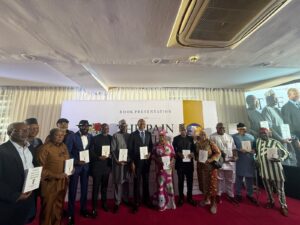
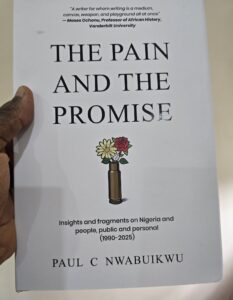
Speaking on Wednesday in Abuja during the public presentation of The Pain and the Promise, a new book authored by communications expert and public affairs analyst, Paul Nwabuikwu, the former Minister of Finance reflected on one of the most defining moments in Nigeria’s economic history, highlighting how public trust and effective communication became critical tools in driving difficult but necessary reforms.
Okonjo-Iweala recalled that she was recruited from the World Bank in 2003 to help rebuild Nigeria’s fragile economy, restore confidence in the country’s public finances and lead negotiations that eventually resulted in the elimination of Nigeria’s estimated $30 billion debt owed to the Paris Club of creditors.
She explained that the sweeping reforms required not only sound economic policies but also the understanding and support of Nigerians, who would inevitably bear the burden of short-term sacrifices for long-term national gains.
“I had been brought in from the World Bank to help straighten up and strengthen Nigeria’s weak finances, including getting rid of $30bn of the country’s debt owed to the Paris Club. To do this work, I knew Nigeria would have to undertake serious economic reforms of the type that would demand understanding and sacrifices from Nigerians,“ she said.
Recognising the importance of winning public confidence, Okonjo-Iweala said she made communication a central pillar of the reform programme and deliberately brought Paul Nwabuikwu into the economic team to lead that effort.
“One important component in my mind then was that we would need a crack communications person or team to help us reach Nigerians, to explain all of this in simple language. That is where Paul came in,“ she said.
She praised Nwabuikwu’s exceptional communication skills, describing him as “smart, articulate, compassionate, a terrific writer and communicator,” and credited him with helping the reform team successfully explain complex economic policies to ordinary Nigerians.
“I can say without fear of contradiction that we wouldn’t have had as much success with the reform programme if we had not had a masterful steering of communications from Paul,“ she said.
According to the WTO chief, successful reforms in a democratic society require far more than policy implementation, stressing that governments must continuously earn the trust of citizens through honest engagement and transparent communication.
“Reform is not just about writing new laws and enforcing new policies. It’s about persuading people, explaining trade-offs and building enough trust that governments can keep pushing through obstacles,“ she added.
Beyond reflecting on Nigeria’s economic reforms, Okonjo-Iweala expressed concern over the country’s persistent ethnic, religious and regional divisions, warning that such fault lines continue to hinder national progress and sustainable development.
She argued that Nigeria must build a shared national vision capable of surviving changes in political leadership if the country hopes to achieve lasting prosperity.
“Until Nigerians can overcome the ethnic, religious and regional divides embedded in our society to forge a social compact that agrees key directions for the nation, directions that remain steady no matter who is in government, I think Nigeria will find it difficult to move forward at the pace required to create enduring prosperity for our people,“ she said.
She further urged Nigerians to embrace merit and professionalism above ethnic or regional considerations, insisting that exceptional talent exists in every part of the country.
“I believe in talent from every corner of Nigeria. There’s no place in Nigeria that doesn’t have talented people. I don’t care what part of the country you come from. I just wanted you to do your job and do it professionally,“ she said.
Reviewing The Pain and the Promise, Okonjo-Iweala described the 300-page publication as an insightful account of Nigeria’s political, economic and social journey over the past three and a half decades.
She said the book blends public commentary, personal experiences and historical reflections to present what she called “a portrait of a generation in the life of the most interesting, if the most chaotic, country in the world.”
She also recommended the publication to young Nigerians, noting that it offers valuable lessons about the country’s history, governance challenges and the importance of civic engagement.
Nigeria’s debt relief remains one of the country’s most significant economic achievements.
In 2005, the nation secured an unprecedented $18 billion debt forgiveness agreement from the Paris Club, eliminating about 60 per cent of its nearly $30 billion bilateral debt. The landmark deal, concluded during President Olusegun Obasanjo’s administration, was fully completed on April 21, 2006, marking a turning point in Nigeria’s economic recovery.
Also speaking at the event, former Minister of Aviation, Osita Chidoka, called for a healthier relationship between government officials, critics and citizens, stressing that national development depends on constructive engagement rather than constant confrontation.
“There is pain, and I must say we all know that much of it is self-inflicted and not necessarily prolonged, but there is also promise in our people, in our creativity, and in the possibility of that thoughtful engagement,“ he said.
Chidoka also drew a distinction between the resilience of ordinary Nigerians and the shortcomings of the Nigerian state, noting that across the country, individuals and businesses continue to rise above ethnic differences by caring for vulnerable people and building successful enterprises without regard to tribe or regional identity. He argued that this spirit of unity and collaboration offers hope 

 for a stronger and more prosperous Nigeria.