
NEWS
Putin’s Party Claims Record Parliamentary Victory as Kremlin Tightens Grip on Russia


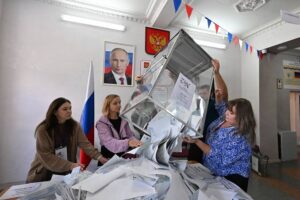
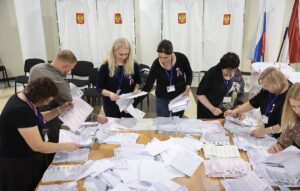
Russian President Vladimir Putin’s United Russia party has secured a record number of seats in the country’s parliamentary election, strengthening its dominance of the State Duma in a vote that was conducted under tight Kremlin control and largely excluded parties and candidates openly critical of the president.
Preliminary results announced by Russia’s electoral authorities showed United Russia winning 355 of the 450 seats in the State Duma, giving the ruling party an even larger supermajority than the 343 seats it secured in the previous election.
The result is expected to further consolidate Putin’s political control as Russia continues to wage its war in Ukraine and faces growing security and economic pressures.
The election was the first parliamentary vote held in Russia since the Kremlin launched its full-scale invasion of Ukraine in 2022.
Authorities have maintained strict restrictions on criticism of the military campaign, while many opposition figures have been imprisoned, excluded from elections or forced to leave the country.
Russia’s only liberal, anti-war party, Yabloko, was barred from competing on the party-list ballot and was permitted to participate only in individual constituency races. Several other politicians opposed to the war were also prevented from taking part in the election.
According to electoral chief Ella Pamfilova, more than 59 per cent of eligible voters participated, making it the highest turnout recorded in a Russian parliamentary election in more than a decade.
Pamfilova also reported that more than 95 per cent of the votes had been counted, with final results expected later in the week. She attributed what she described as psychological pressure surrounding the election to the difficult circumstances facing the country and accused Ukraine of being responsible for more than 1,000 cyberattacks targeting Russia’s electronic voting system.
United Russia’s overwhelming victory left the Kremlin-backed political establishment firmly in control of the legislature. The Communist Party finished second with 40 seats, while the nationalist LDPR secured 25 seats and New People won 20 seats.
Although some of the parties represented in parliament have occasionally criticised aspects of government policy, they have generally supported major Kremlin initiatives and have not mounted a sustained parliamentary challenge to Putin.
The role of electronic voting also became a major point of controversy. Authorities promoted online voting across numerous regions, while critics argued that the system reduced transparency and created additional opportunities for officials to influence or control the outcome.
Yabloko and the Communist Party also alleged that some of their election observers were prevented from entering polling stations or carrying out their monitoring duties.
International scrutiny was limited after Russia declined to invite observers from the Organization for Security and Cooperation in Europe.
Russian authorities accused the organisation of applying double standards in its treatment of Moscow, while OSCE Parliamentary Assembly President Pere Joan Pons said the decision violated commitments Russia had undertaken as a member of the organisation.
Images from polling stations also showed armed soldiers overseeing voting in some locations, underscoring the heightened security environment surrounding the election.
The parliamentary vote took place against the backdrop of growing fears over a possible new military mobilisation.
Although Putin has denied plans for another nationwide call-up, Ukrainian officials have accused Moscow of preparing for additional recruitment in the coming weeks.
Those concerns have been amplified by an increase in Ukrainian drone attacks against targets deep inside Russian territory. Kyiv has increasingly used long-range drone operations to strike strategic infrastructure and demonstrate that the war can reach far beyond the battlefield.
On the final day of voting, Moscow and surrounding areas were targeted by hundreds of drones, with three people reportedly killed in the attacks.
Ukrainian President Volodymyr Zelensky said the strikes damaged one of Russia’s key oil facilities, adding another layer of pressure on Moscow as it seeks to protect critical energy infrastructure.
Russia has responded by expanding its anti-drone defences around important installations, including oil facilities in the capital.
Footage circulating from the area appeared to show workers installing enormous protective nets over an oil refinery, with the structures suspended on extensive scaffolding.
The election result therefore comes at a particularly sensitive moment for the Kremlin. With United Russia securing its largest-ever parliamentary majority, Putin enters the next phase of the war with his ruling political bloc maintaining overwhelming control of the legislature, while Russia continues to confront battlefield pressures, drone attacks, international isolation and growing specula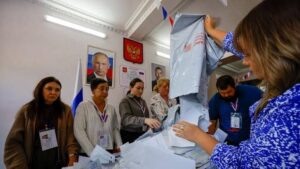

 tion over further military mobilisation.