
NEWS
Spain Shuts Airspace to US War Flights, Declares US–Israel Offensive on Iran ‘Profoundly Illegal and Unjust’ Amid Escalating Diplomatic Rift

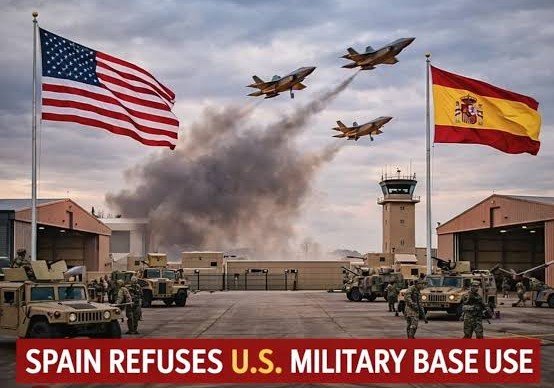
Spain has taken a dramatic and unprecedented step in its opposition to the ongoing US–Israel war on Iran, officially closing its airspace to American military aircraft involved in the conflict. The move marks a significant escalation in Madrid’s stance, reinforcing its position as one of Europe’s most outspoken critics of the war.
The decision, first reported by El País and later confirmed by Spain’s Defence Minister, Margarita Robles, came on Monday and follows an earlier directive barring the United States from using jointly operated military bases within Spanish territory for operations connected to the conflict.
“We don’t authorise either the use of military bases or the use of airspace for actions related to the war in Iran.
“I think everyone knows Spain’s position. It’s very clear,” she added, calling the war “profoundly illegal and profoundly unjust,” Robles told reporters.
The closure of Spanish airspace is expected to have immediate operational consequences for US military logistics. Aircraft stationed in the United Kingdom and across Europe will now be forced to reroute around Spain when heading toward the Middle East, except in cases classified as emergencies. This adds both time and complexity to already sensitive military operations in the region.
Spain had earlier denied access to key military installations such as Rota and Morón de la Frontera bases critical to US operations in Europe further tightening restrictions on American military movements linked to the war.
Spain’s Prime Minister, Pedro Sánchez, has emerged as a leading European voice condemning the conflict, placing him at odds with former US President Donald Trump. Sánchez has consistently called for an immediate halt to hostilities, urging all parties, the US, Israel, and Iran to de-escalate.
“You can’t respond to one illegality with another because that’s how humanity’s great disasters begin,” Sánchez warned, underscoring his government’s moral and legal objections to the war.
The Spanish government’s refusal to support US operations has reportedly triggered retaliatory threats from Trump, including the possibility of cutting off trade relations with Madrid, an indication of the deepening diplomatic rift between the two allies.
Spain’s Economy Minister, Carlos Cuerpo, defended the government’s decision, emphasizing its legal and ethical foundations.
“This decision is part of the decision already made by the Spanish government not to participate in or contribute to a war which was initiated unilaterally and against international law,” he stated during a local radio interview.
Sánchez had already signaled the airspace restriction during a recent address to the Spanish Congress, revealing that Spain had not only denied access to military bases but also rejected all flight plans connected to the war, including refuelling missions.
Despite the restrictions, US military aircraft are still permitted to use Spanish bases under existing bilateral agreements, particularly for logistical support of the approximately 80,000 American troops stationed across Europe. However, operational adjustments are already underway.
In late February, 15 US KC-135 refuelling aircraft were relocated from Spanish bases to facilities in France and Germany, indicating a shift in strategic positioning.
Responding to reports by El Mundo claiming that at least 70 US military flights had used Spanish bases since the conflict began, Robles clarified that those flights were limited to transport operations and did not involve fighter jets or refuelling aircraft linked to combat missions.
While US bombers such as B-2 and B-52 have historically operated from Spanish bases during military exercises, their use in direct combat operations from Spain remains extremely rare. The last instance occurred during the Gulf War under the socialist government of Felipe González.
Spain’s firm stance is reshaping the diplomatic landscape in Europe, positioning the country as a moral counterweight within NATO and the broader Western alliance. As tensions surrounding the US–Israel war on Iran continue to mount, Madrid’s decisions could influence other European nations grappling with the legal and ethical implications of the conflict.
For now, Spain has made its position unmistakably clear: it will neither support nor facilitate what it views as an unlawful war.