
NEWS
“The moment they announce his victory, I will cut my green card myself and start packing up.” — Nobel Laureate, Wole Soyinka Says, Reflects on His “Wolexit” and Protest Against Trump’s Xenophobia, as U.S. Revokes Visa

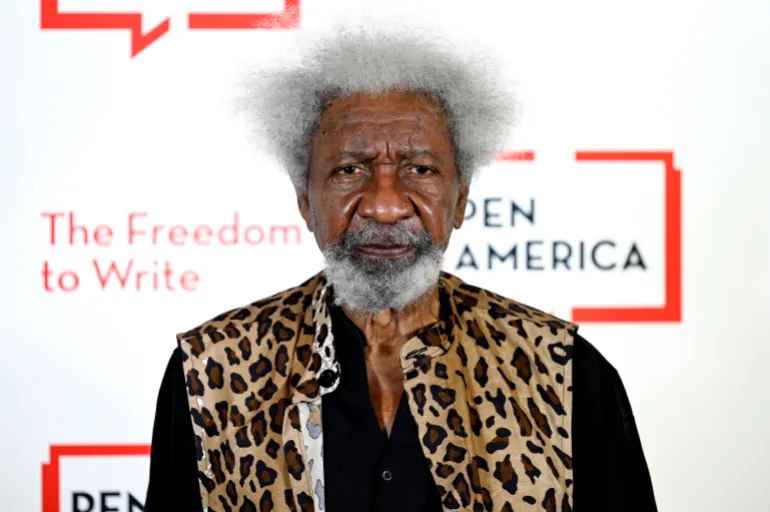
In a development that has reignited discussions about his long-ago protest against Donald Trump’s presidency, Nobel Laureate Prof. Wole Soyinka has reportedly had his U.S. non-immigrant visa revoked by the American government. The revocation comes years after Soyinka symbolically renounced his U.S. residency in what he famously termed “Wolexit.”
According to a letter dated October 23 from the American Consulate-General in Lagos, the U.S. government directed the internationally acclaimed playwright to present his passport for visa cancellation, citing “additional information obtained after issuance.”
Soyinka confirmed the development but clarified that he had not been informed of any specific offence linked to the decision. The 89-year-old Nobel Laureate explained that he applied for the visa after receiving a letter from the U.S. Internal Revenue Service (IRS) about an audit related to his tax returns. His intention, he said, was to travel to the U.S. to resolve the tax issues and prevent any situation where the U.S. might publicly brand him as a “tax dodger.”
In 2016, Wole Soyinka, the first African to win the Nobel Prize in Literature, had confirmed that he had rendered his U.S. green card “inoperable” following Donald Trump’s shock victory in the presidential election.
Earlier that year, on November 2, 2016, while speaking at Oxford University’s Ertegun House, Soyinka had declared that if Trump won, he would initiate what he called a “Wolexit” by destroying his green card and cutting ties with the United States.
“The moment they announce his victory, I will cut my green card myself and start packing up,” the Nobel laureate had said.
True to his words, Soyinka later confirmed during a conference in South Africa that he had indeed carried out his symbolic protest.
“I have already done it; I have disengaged (from the United States). I have done what I said I would do.
“I had a horror of what is to come with Trump… I threw away the (green) card, and I have relocated, and I’m back to where I have always been. As long as Trump is in charge, if I absolutely have to visit the United States, I prefer to go in the queue for a regular visa with others,” he stated.
Soyinka described his “Wolexit” as a deeply personal protest against Donald Trump’s xenophobic rhetoric, which he said targeted Blacks, Hispanics, and Muslims during the U.S. presidential campaign. His stand was widely reported across international media as a symbolic act of resistance against intolerance and racial discrimination.
The Nobel Laureate had originally obtained his U.S. green card in the 1990s during a political sabbatical at Emory University, facilitated with assistance from former U.S. President Jimmy Carter.
A lawful permanent resident like Soyinka can voluntarily abandon or relinquish U.S. residency, typically by filing Form I-407 (Record of Abandonment of Lawful Permanent Resident Status) with the U.S. Citizenship and Immigration Services (USCIS) or at a U.S. consulate abroad.
However, abandonment can also occur informally if the person stops residing in the U.S. and demonstrates an intention to sever residency ties as Soyinka did in 2016.
The recent visa revocation, therefore, appears to close a long chapter in Soyinka’s decades-long relationship with the United States, one that began with academic engagement and ended in political protest.
Though the U.S. government has not officially disclosed reasons for the visa cancellation, the development underscores Soyinka’s complex relationship with the West, a bond shaped by scholarship, activism, and unflinching principles.
As one of Africa’s most respected literary and moral voices, Prof. Wole Soyinka’s “Wolexit” continues to resonate nearly a decade later as a testament to personal conviction in the face of political disillusionment.