
NEWS
Abia State Govt Moves to End Poor Project Delivery as ASPIB Hosts High-Level Capacity Building Workshop for Contractors, MDAs on Quality Assurance and Global Infrastructure Standards


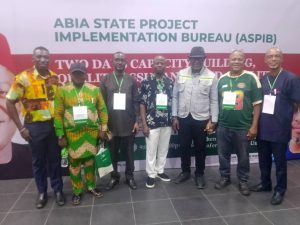
The Abia State Government has taken a decisive step towards strengthening the quality and durability of public infrastructure projects with the commencement of a two-day capacity-building workshop for contractors and government officials.
The workshop, organised by the Abia State Project Implementation Bureau (ASPIB), is designed to address the persistent challenges of poor project execution while ensuring that infrastructure projects across the state meet internationally recognised standards.
The training programme focuses on quality assurance and quality control processes that will significantly improve project delivery while guaranteeing that public funds invested in infrastructure yield lasting value for the people of Abia State.
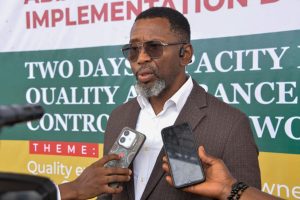
Speaking at the opening session on Wednesday at the International Conference Centre in Umuahia, the Director-General of ASPIB and convener of the workshop, Mr Onyinye Nwosu, explained that the initiative was designed to deepen collaboration between contractors and Ministries, Departments and Agencies (MDAs) responsible for project implementation.
Mr Nwosu noted that the workshop, themed “Quality Execution: A Shared Ownership in Building High Quality Resilient Infrastructure Through Collaborative Project Management,” aims to improve technical capacity among stakeholders and ensure that projects executed within the state meet globally accepted standards of construction and durability.
According to him, the programme aligns with the administration’s broader vision of delivering durable infrastructure that will stand the test of time while reinforcing the government’s commitment to transparency and accountability in project implementation.
He emphasised that the workshop reflects Governor Alex Otti’s commitment to excellence in infrastructure development and sustainable project delivery across Abia State.
“Today we are hosting our two-day capacity building workshop where we are bringing in our contractors and also the MDAs in the State Government for a collaborative session.
“We all know that our dear Governor has transformed the State into a massive construction site.
“In order to make sure that we deliver quality infrastructure that can stand the test of time and be sustainable, even when this administration has left, we have to make sure that we execute the right, quality assurance and quality control processes.
“So this is a workshop where we can talk about our processes and also the quality management plan that the state government has put in place to be able to track what goes on, on site, system that guides everybody,” the ASPIB boss said.
He further explained that the workshop was carefully structured to help contractors, engineers and other stakeholders understand the technical requirements of quality assurance and quality control procedures required for public infrastructure projects.
Mr Nwosu stressed the importance of planning infrastructure with a long-term outlook, insisting that projects must be designed and executed to serve future generations.
“We have to think about 50 to 100 years from now. That means putting in place the right quality assurance and quality control processes. It cannot be done without carrying along our contractors and other stakeholders,” Nwosu added.
Also speaking during the workshop, Engr. Prince Chukwudi, who presented a paper on geotechnical and geological exploration, highlighted the critical importance of conducting proper soil and site investigations before the commencement of construction projects.
According to him, a significant number of infrastructure failures recorded across many regions occur because construction begins without adequate geological and geotechnical studies.
He explained that proper geotechnical exploration ensures that engineering designs are compatible with the physical realities of construction sites, thereby preventing structural failures and unnecessary cost increases during project execution.
“If a project is supposed to cost about $100,000, lack of proper geological exploration could push the cost to $200,000 or more. That is why these investigations are critical before any construction begins,” he said.
A participant at the workshop and Senior Project Controller at the Bureau, Mr Chukwuma Okolo, described the initiative as a bold and strategic move toward reforming project implementation systems in Nigeria.
He observed that the programme could help tackle the longstanding problem of abandoned, substandard or poorly executed public projects that have plagued the country for decades.
Okolo noted that the establishment of ASPIB by Governor Alex Otti was a deliberate intervention designed to address historical inefficiencies and financial waste associated with infrastructure development.
“ASPIB was created with good intentions after studying the enormous wastage that has occurred since independence. We are talking about billions of dollars spent on projects that did not deliver value.
“ASPIB is essentially a preventive mechanism. It ensures that projects are done according to prescribed standards so that contractors and government officials alike are protected and public funds are not wasted,” he stated.
The workshop is expected to strengthen institutional capacity among contractors and government officials, improve project supervision, and reinforce the state government’s determination to deliver durable, high-quality infrastructure that will support economic growth and develop
 ment across Abia State for decades to come.