
NEWS
JUST IN: First Niger Bridge Reopens After Rehabilitation as Umahi Hails Tinubu, Declares South-East Support for 2027

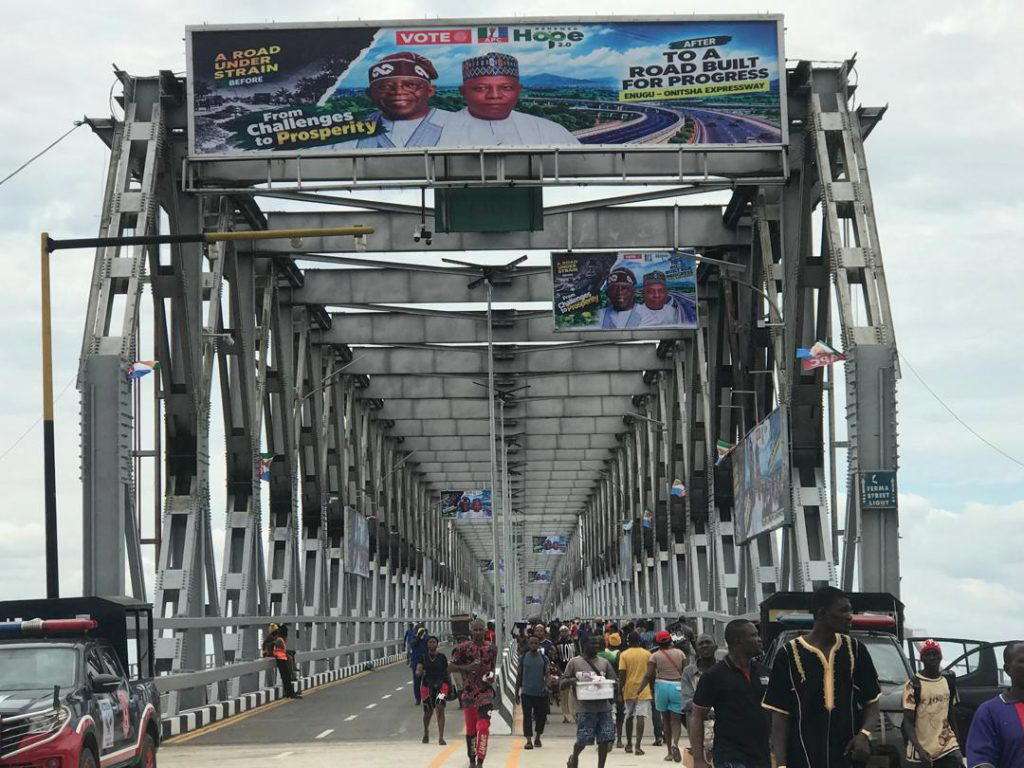
The Federal Government on Thursday, October 15, 2026, reopened the historic First Niger Bridge linking Onitsha in Anambra State with Asaba in Delta State following the completion of emergency rehabilitation and maintenance works, with campaign billboards, photographs of President Bola Tinubu and other political figures prominently displayed on the bridge.
The reopening marked the end of weeks of traffic disruption on the strategic river crossing, which serves as a major transportation link between the South-East and South-South regions and facilitates the movement of commuters, traders, goods and commercial vehicles across the River Niger.
However, beyond the restoration of traffic, the reopening attracted political attention following the display of Tinubu’s photographs, Vice-President Kashim Shettima’s images, those of Anambra State Governor Chukwuma Soludo and All Progressives Congress (APC) campaign banners along sections of the bridge.
The Minister of Works, Sen. David Umahi, who presided over the reopening, used the occasion to highlight the Tinubu administration’s infrastructure projects, defend its performance in the South-East and South-South, and express confidence that the region would deliver greater electoral support for the President in the 2027 general elections.
Built in 1965, the First Niger Bridge is one of Nigeria’s most important transport infrastructure assets. Its strategic location makes it a critical gateway connecting commercial activities in Onitsha, one of the country’s major trading centres, with Asaba and other parts of southern Nigeria.
The bridge was closed to traffic on September 7, 2026, to enable emergency rehabilitation and maintenance works, which were initially scheduled for completion on September 21.
The closure, however, extended beyond the original deadline following persistent rainfall and other unforeseen circumstances that disrupted the work schedule.
The rehabilitation became necessary after the discovery of vandalised structural components, including steelwork around the bridge’s expansion joints, raising concerns about the condition of critical elements of the ageing infrastructure.
Following the completion of the work, the reopening restored access across the bridge, although finishing touches were still being carried out on some sections of its railings at the time of the ceremony.
Umahi praised President Tinubu for what he described as his administration’s commitment to infrastructure development across the South-East and South-South, insisting that ongoing projects demonstrated the Federal Government’s willingness to address the region’s infrastructure needs.
The minister drew a comparison between the rehabilitation and maintenance of the First Niger Bridge and similar interventions on other major bridges across the country, including the Third Mainland Bridge in Lagos and the Second Niger Bridge.
According to him, the infrastructure projects being undertaken by the Federal Government reflect a broader commitment to improving transportation networks, strengthening connectivity and supporting economic development across different regions of Nigeria.
He maintained that the South-East and South-South would benefit from the administration’s infrastructure agenda, adding that more projects would be extended to other parts of Anambra State.
During his address, Umahi intermittently sang “On Your Mandate We Shall Stand” as he expressed support for Tinubu and the APC ahead of the 2027 elections.
The minister also took aim at the Labour Party’s 2023 presidential candidate, Peter Obi, and the Obidient Movement, questioning whether the former Anambra State governor could match Tinubu’s performance in office.
“I am not into regional politics; I am following who is performing.
“Can anybody give us the alternative to President Tinubu, who has salvaged the country from a catastrophic situation? Can Peter Obi do what Tinubu is doing?” he asked.
Umahi’s remarks placed the bridge reopening within the broader political debate over infrastructure delivery, regional inclusion and the performance of the Tinubu administration as political activities gradually gather momentum ahead of the 2027 general elections.
He further disclosed that the Federal Government had approved the dualisation of the Oba-Okigwe Expressway, presenting the project as another indication of the administration’s infrastructure commitments to the South-East.
“The President has approved the dualisation of Oba-Okigwe Expressway. Why are people not seeing all these?
“Democracy is about development and infrastructure. We are here to demonstrate that the South-East is for President Tinubu,” Umahi said.
The minister acknowledged that the South-East had not delivered overwhelming electoral support for Tinubu during the 2023 presidential election. He attributed the outcome to what he described as the unfavourable treatment of the region under the administration of former President Muhammadu Buhari.
He nevertheless expressed optimism that the political situation would change in 2027, predicting that the South-East would give Tinubu stronger support based on the infrastructure projects and other interventions being pursued by the current administration.
Umahi also addressed the display of political advertisements on the bridge, insisting that federal highways and associated infrastructure could not be used for billboards without the necessary authorisation.
“No one has the right to put billboards on the federal highways. Tell Peter Obi and the Obidient Movement that if they pay, they will be allowed to put their billboards on the highways,” he said.
The minister’s comments came amid the conspicuous display of campaign-related materials featuring Tinubu and other political figures on the bridge railings, alongside APC banners.
Campaign billboards and banners of President Tinubu, Vice-President Kashim Shettima and Governor Chukwuma Soludo were visible on sections of the bridge, while some railings had been repainted as part of the finishing work associated with the rehabilitation exercise.
Painters were still attending to portions of the railings, while road markings had been repainted to improve visibility and guide motorists using the bridge.
Closed-circuit television cameras had also been installed at various sections, alongside other infrastructure components intended to support monitoring and improve the management of the bridge.
The display of the President’s photographs followed an earlier inspection during which Umahi directed that unauthorised advertisements be removed from the bridge and that Tinubu’s photographs be displayed after the rehabilitation work was completed.
The minister had explained that the move was intended to recognise what he described as the President’s contributions to infrastructure development in the South-East.
The reopening of the First Niger Bridge therefore represented both the restoration of a vital transportation route and a fresh platform for the Federal Government to showcase its infrastructure agenda in the region.
While the rehabilitation addressed identified structural concerns and restored traffic across the historic crossing, Umahi’s remarks also underscored the growing intersection of infrastructure delivery and political messaging as the country approaches another general election cycle.
For motorists, traders and businesses that depend on the bridge for daily movement between Anambra and Delta states, the return of normal traffic is a significant development. Politically, however, the minister used the occasion to reinforce the Tinubu administration’s record and make a case for stronger South-East support for the President in 2027.