
NEWS
Works Minister, David Umahi Under Fire Over “It’s Not Yet Our Turn” Remark, as Critics Challenge Claim That Tinubu’s Presidency Belongs to Him

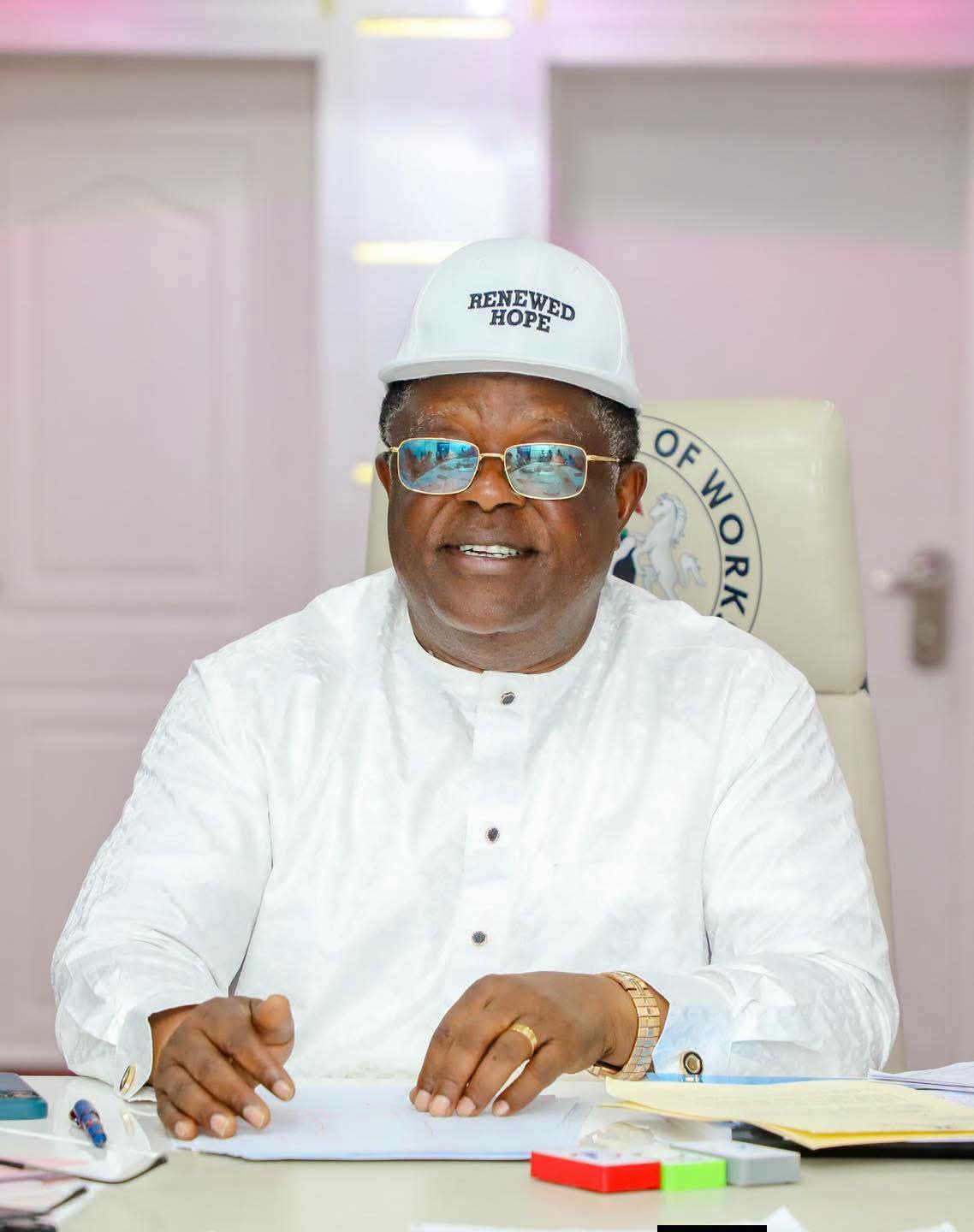
Minister of Works and former Ebonyi State Governor, Senator David Umahi, has come under intense criticism following his recent comments on the zoning of Nigeria’s presidency and the South-East’s aspiration to produce the nation’s president.
Umahi’s remarks have generated a wave of reactions, particularly his assertion that it is not yet the turn of the Igbo to produce the president and his position that the current political moment belongs to President Bola Tinubu.
The controversy has also reignited the long-running national debate over whether Nigeria’s informal power rotation is between individuals, political regions or the six geopolitical zones, with Umahi’s critics arguing that presidential rotation has historically been understood within the broader North-South arrangement rather than as a turn-by-turn entitlement for individual politicians.
Umahi made the remarks in Benin while speaking about the Federal Government’s ongoing road interventions and defending the Tinubu administration against criticism.
The minister also took a swipe at former Anambra State Governor and Nigeria Democratic Congress (NDC) presidential candidate, Peter Obi, following comments comparing the political stature of the two South-East politicians.
Umahi said he was prompted to examine Obi’s record after hearing that he was not a match for the former Anambra governor.
“When that guy said that Peter Obi is not my match, it took me 10 minutes to think about it.”
He subsequently questioned the basis for comparing the two politicians, asking whether Obi possessed a stronger family background, superior intellectual credentials or a more substantial record of service to the South-East.
“Is it about what we have done for the people of the South-East? Is it about what we did when we were governors?
“So, when you say he’s not my match, put it side by side and tell me in what way Obi is better than me,” he said.
The minister also rejected criticisms aimed at the Tinubu administration, particularly claims that the Federal Government had failed to deliver meaningful infrastructure across the country.
He argued that ongoing road and other infrastructure projects were having tangible impacts in different parts of Nigeria and urged supporters of the administration to highlight what he described as its achievements.
The debate, however, took a more politically sensitive turn when Umahi addressed the South-East’s long-standing aspiration to produce a Nigerian president.
“What we are saying is that it’s not the turn of the Igbo yet.”
Umahi acknowledged that the South-East would eventually have an opportunity to produce the country’s president, but maintained that the present political period belongs to Tinubu.
“I want to be president, but it’s not yet our turn. It’s the turn of President Bola Tinubu,” he said.
He further suggested that the South-East’s opportunity would come at the appropriate time, adding, “When it is our turn, at the time of God, He makes all things beautiful.”
Umahi subsequently called on supporters of the Tinubu administration to defend the president’s record across the country, particularly in the South-East and South-South.
“We are saying that the president has done very well. In South-South, in South-East and in the entire geopolitical zone, he deserves continuity, he deserves support,” the minister said.
The comments have since triggered strong reactions online and among political commentators, with critics questioning the basis of Umahi’s argument that the presidency is currently Tinubu’s turn rather than the turn of a particular geopolitical zone.
One of the prominent voices criticising the minister is public affairs analyst Adedayo Oluwatosin, who accused Umahi of putting his personal political interests ahead of the broader aspiration of the South-East.
“I call what Umahi is doing selfishness. He is not happy that Obi is more popular than him. Didn’t you hear what he said? He said he would want to be president, but it is not the Igbo’s turn yet, rather Tinubu’s turn. He is scheming to position himself, maybe, for the position of vice president in 2031.
“Otherwise, how can anybody say it is not the Igbo’s turn yet? Power rotates between the North and the South. When you talk about the South, Obasanjo (South-West) has been president for eight years, and Goodluck Jonathan (South-South) has been president for five years.
“It is only the Igbo (South-East) that has not produced a president. That was why most Nigerians voted for Obi in 2023, apart from the fact that he was the best candidate then.
“Today, he still remains the best candidate in terms of integrity, capacity and competence. And he still remains the candidate from the zone that has not produced the president of this country since 1999, when this Fourth Republic began.
“So, when Umahi said it is not the turn of the Igbo yet, one may want to ask him. “Is it when power moves back to the North in 2031? So, that statement is full of deceit and jealousy,” he stated.
Oluwatosin also challenged Umahi’s comparison of himself with Obi, bringing the former Anambra governor’s business career into the argument.
“Did Umahi think that he is Obi’s match? Does he need anybody to tell him that they are poles apart? In 1996, Obi bought a property worth one million pounds in the United Kingdom, three years before Nigeria’s return to democracy in 1999 and almost 10 years before he ventured into politics as Anambra State governor.
“Where was Umahi in 1996? Obi became wealthy through his personal sweat. Umahi became wealthy through politics. If not for politics, can he be in the same gathering with Obi? So, there is no comparison between the two, actually.”
Another critic, Lagos businessman Chidozie Okafor, argued that Umahi’s position reflected what he described as a desire among some politicians to remain politically relevant and retain government influence.
He also linked the controversy to the wider 2027 presidential contest and the growing support for Obi among sections of the electorate.
“In Nigeria, there is nobody who doesn’t know that it is the turn of the Igbo to produce the next president in 2023.
“Obi presented himself for the job and Nigerians loved him and voted massively for him, but his mandate was stolen by the electoral umpire.
“Now, that window is still open till the next four years, and Nigerians are saying that this time, we must vote for Obi and ensure that we guard our votes so that nobody will steal it again, and somebody like Umahi is crying wolf.
“Umahi’s argument can only make sense to people like him; people who are envious of Obi’s rising profile.
“But there is nothing he can do because Nigerians have decided that on January 16, 2027, they will vote for Obi. Their decision is hinged on the fact that, first, it is the turn of the Igbo and, secondly, he is the most competent of all the candidates.
“So, leave Umahi to his own opinion; it is his right, but we all know where he is coming from, just that this time, such a trick will not work. It is too late in the day.
“Even the North has agreed that the Igbo should be given the opportunity since every other zone in Nigeria has tried its best and Nigeria is still not working.
“Let an Igbo man try and see if things can improve,” he stated.
Okafor also dismissed Umahi’s insistence that he should be compared with Obi on the basis of political records, using another metaphor to underline his position.
“As for whether Umahi is Obi’s match, that is not in contention. He is not Obi’s match at all. He wanted to know the criteria.
“I won’t say it here because some people may accuse me of committing libel, but the minister should just know that the difference between him and Obi is like darkness and light. He represents darkness while Obi represents light, and I am sure he knows that darkness is no match for light.”
Lagos-based lawyer Marcellus Onah also weighed into the controversy, describing the attacks against Obi as evidence, in his view, of the former Anambra governor’s increasing political visibility.
Onah argued that Umahi’s position could not determine the wider political conversation surrounding the South-East’s presidential aspiration.
“So, forget about Umahi and his co-conspirators. He doesn’t know that the train has left him. I pray that he will be alive to see Obi contest the 2027 presidential election, win and be sworn in. No amount of lies, character assassination, mudslinging or jealousy can change what God has ordained,” he said.
Another commentator, James Okoye, expressed disappointment that some South-East politicians were criticising Obi while, according to him, politicians and supporters from other parts of the country were backing the former Anambra governor.
“But I have a message for Umahi and his co-conspirators. Nigerians have found succour in Obi, and there is nothing he and his likes can do to stop that. Obi’s record is what is speaking for him.
“Here is a man whom all the anti-graft agencies have scrutinised from head to toe without anything to hold him down. No politician in Nigeria has such a record. That is the man Umahi is challenging those who said he is not his match to show him the reasons.
“Can Umahi honestly subject himself to the anti-graft agencies’ scrutiny of his tenure as Ebonyi governor? He can’t because if he does, a can of worms will be unravelled. That’s just his tenure as governor, not to talk of his tenure as deputy governor, state chairman of the Peoples Democratic Party (PDP) or his current position as minister.
“So, he should just allow the sleeping dog to lie peacefully and let Nigerians continue to love Obi until he becomes president in 2027,” he stated.
The controversy has therefore moved beyond a disagreement between two South-East politicians, touching on one of Nigeria’s most enduring political questions: whether the country’s informal rotation of the presidency should be interpreted primarily through the North-South divide, through the six geopolitical zones, or according to the political calculations of individual parties and candidates.
While Umahi maintains that the South-East will have its opportunity at the appropriate time and that the current moment belongs to Tinubu, his critics argue that the South-East’s exclusion from the presidency since the beginning of the Fourth Republic is central to their argument for an Igbo presidential bid.
With the 2027 political contest already generating intense alignments across the country, Umahi’s comments are likely to remain part of the broader debate over zoning, political rotation, regional representation and the competing ambitions of politicians seeking influence ahead of the next presidential election.