
NEWS
U.S. President Donald Trump Orders Major Cut to US-South Korea Military Drills, Citing Ties With Kim Jong Un

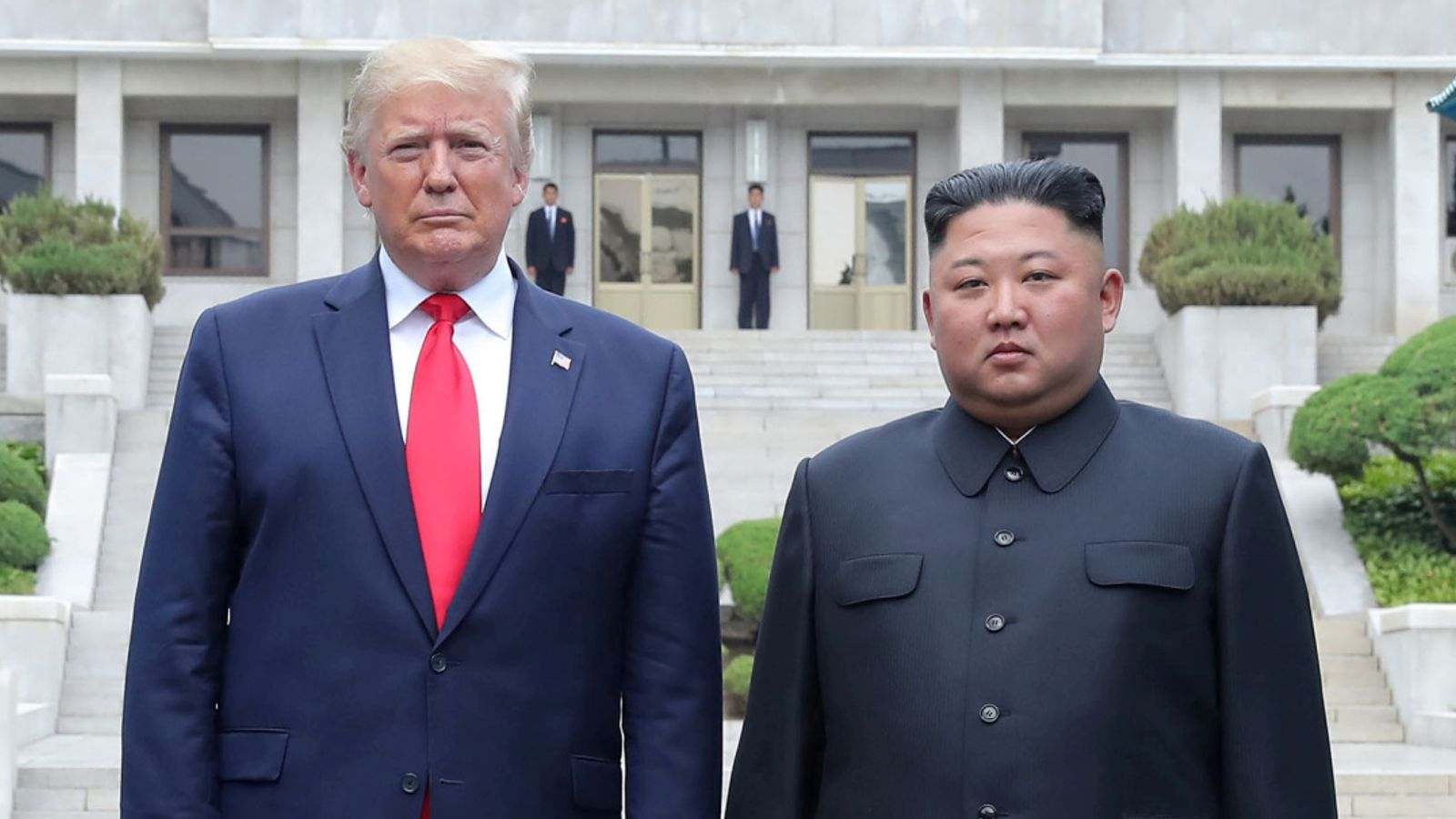
U.S President Donald Trump has ordered a substantial reduction in joint military exercises between the United States and South Korea, citing his close relationship with North Korean leader Kim Jong Un, the cost of the drills and Seoul’s refusal to support Washington’s efforts over Iran.
Trump made the announcement in a post on his official social media account on Sunday, August 16, 2026, saying he was unhappy that the United States had previously agreed to participate in the exercises with South Korea.
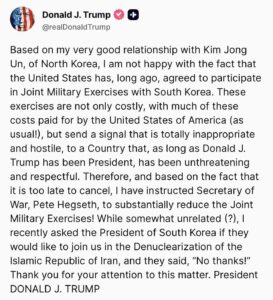
“Based on my very good relationship with Kim Jong Un, of North Korea, I am not happy with the fact that the United States has, long ago, agreed to participate in Joint Military Exercises with South Korea,” Trump wrote.
The President argued that the exercises were expensive for Washington and sent what he described as an inappropriate and hostile message to North Korea.
“These exercises are not only costly, with much of these costs paid for by the United States of America (as usual!), but send a signal that is totally inappropriate and hostile, to a Country that, as long as Donald J. Trump has been President, has been unthreatening and respectful,” he said.
Trump said cancelling the exercises outright was no longer possible because of their timing, but disclosed that he had instructed Secretary of War Pete Hegseth to significantly scale them back.
“Therefore, and based on the fact that it is too late to cancel, I have instructed Secretary of War, Pete Hegseth, to substantially reduce the Joint Military Exercises!”
The announcement came just as the annual Ulchi Freedom Shield exercises were due to begin. The drills, which involve thousands of South Korean troops alongside US forces, are designed to strengthen the allies’ ability to respond to threats on the Korean Peninsula. Despite Trump’s announcement, South Korea said the exercises were proceeding as scheduled.
Trump’s decision also introduced a striking new dimension to the already complicated US-South Korea relationship. In his post, he linked the military issue to Seoul’s position on the conflict involving Iran, revealing that he had asked South Korean President Lee Jae Myung whether South Korea would support US efforts toward the denuclearization of Iran.
“While somewhat unrelated (?), I recently asked the President of South Korea if they would like to join us in the Denuclearization of the Islamic Republic of Iran, and they said, “No thanks!””
The remarks have heightened concerns about the future of the US-South Korea security alliance, particularly as North Korea continues to expand its military and nuclear capabilities. Analysts have warned that reducing the exercises could affect military preparedness and deterrence, although South Korea has also expressed hope that the move could help create an opening for renewed dialogue between Washington and Pyongyang.
Trump has previously pursued a reduction or suspension of US-South Korean military exercises as part of efforts to improve relations with Kim. His latest decision therefore revives an approach that has featured prominently in his dealings with North Korea, even as the security environment on the Korean Peninsula has changed considerably.
North Korea has continued to condemn the exercises as provocative, while recent developments have raised concerns about its growing military capabilities and closer relations with Russia.
Trump concluded his post with a brief appeal for attention to his decision, signing off as “President DONALD J. TRUMP.”
The move is now likely to fuel fresh debate in Washington and Seoul over how the United States should balance military readiness, alliance commitments and Trump’s pursuit of a direct re
 lationship with Kim Jong Un.